

Every week a client sits in my chair the night before an interview, a promotion panel, or a first day at a new firm, and asks the same nervous question: “Do I need to shave this off?” Almost never. What gets men in trouble at work isn’t the beard — it’s the loose neckline, the fuzzy cheeks, the week-old edges. A beard with deliberate lines reads as attention to detail; a beard without them reads as “didn’t bother.” And the timing has never been better: workplace surveys now show more than 80% of offices accept well-groomed facial hair, and the big shift I’m seeing this year is precision over volume — shorter, sharper, faded beards that look engineered rather than grown. This guide covers the 30 styles I actually trim for working men, with the exact lengths and guard numbers to ask for.
Want it looking barber-fresh? See my pick of the right beard trimmer to keep it sharp.
Key Takeaways
- Precision beats volume this year — short, sharp, faded beards are what’s walking out of every good barbershop
- Corporate boxed beard and executive stubble are the two safest choices for conservative offices
- The neckline rule: two fingers above the Adam’s apple — everything below it goes, every time
- Stubble is office-appropriate when it’s one even guard length all over — patchy or uneven stubble is not
- Book a professional trim every 2–3 weeks; do the small maintenance yourself between visits
Look Boardroom-Sharp Every Day
A professional beard has to look deliberate by 9am. These keep it neat, controlled and office-ready without a trip to the barber every week.
Viking Revolution Beard Oil
A few drops a day softens the hair, kills the itch and stops the flakes. The cheapest habit that makes any beard look intentional.
Check it on Amazon →Viking Revolution Ultimate Beard Kit
Oil, balm, boar brush, comb and scissors in one box. If you’re serious about the look, this is the whole routine sorted — my pick for most men.
Check it on Amazon →Philips Norelco Beard Trimmer
Sharp cheek and neck lines are what separate “groomed” from “scruffy.” A trusted trimmer makes them easy to hold week to week.
Check it on Amazon →As an Amazon Associate, I earn from qualifying purchases — at no extra cost to you. Current price and availability are shown on Amazon.
What Is A Professional Beard?
A professional beard is any beard that looks like a decision, not an accident. In practice that means three things I check on every client before they leave my chair: a defined neckline (nothing creeping down the neck), a tidy cheek line (natural or sharpened, but never fuzzy), and a length that’s consistent across the whole face. Style matters less than most men think — I’ve groomed full beards for lawyers and heavy stubble for bankers, and both passed the boardroom test because the edges were clean. My rule of thumb: if your beard would survive a close-up on a video call without you tilting the camera, it’s professional. If you’re squinting at your jawline wondering, it needs a trim.

How To Maintain A Professional Beard For The Office
Here’s the routine I give every client who works in an office, and it takes under five minutes a morning. Wash the beard two or three times a week with a proper beard wash — daily shampooing strips it dry and gives you flakes on a dark suit, which is the fastest way to look unkempt. Every morning, work three or four drops of beard oil into the skin underneath, then brush everything downward with a boar-bristle brush to train the hair flat.
For the lines: keep the neckline two finger-widths above the Adam’s apple and shave everything below it clean — do this twice a week. Run your trimmer over the whole beard at your set guard every three to four days so the length never drifts. The barbershop visit every two to three weeks handles the shaping; your job between visits is simply not letting it slip.

Best Face Shapes For Professional Beards
Before you pick from the beard styles below, be honest about your face shape, because the same beard can sharpen one man and swallow another. Oval faces get away with nearly everything — pick based on your growth pattern and your office. Round faces need length at the chin and tight sides; think ducktail or extended goatee, never a wide full beard.
Square jaws are already strong, so I round the corners slightly and keep things short — heavy stubble and the rounded beard work beautifully. Long or rectangular faces need the opposite: fuller cheeks, shorter chin, so the beard adds width instead of more length. Get this matching right and even a simple stubble looks tailored to you.

Short Corporate Beard
If a client tells me “strict office, first beard, don’t get me in trouble,” this is what I give him. The short corporate beard sits at 4–10mm — that’s guard 2 to guard 3 on most trimmers — with a shaved neckline and a lightly cleaned cheek line. It’s long enough to read as a real beard, short enough that HR has nothing to say.
Ask your barber for “an all-over grade 2 or 3 with a clean neckline, natural cheeks.” Maintenance is a whole-beard pass every three to four days and oil each morning. It works in banking, law, sales, anywhere — the navy suit of beards, and the one I trim most for men over 30.

Executive Stubble Style
Executive stubble is 2–3mm — a guard 1 on most trimmers — kept ruthlessly even. The difference between this and “forgot to shave” is entirely in the edges: the neckline is shaved clean and the cheek line is tidied, so the stubble looks placed rather than left. It’s the style I trim for the most senior men I cut, because it photographs well, works with grey coming through, and never triggers a dress-code conversation.
The catch is frequency. At this length there’s nowhere to hide, so you’re running the trimmer every other day without fail. Skip two days and you’ve drifted into scruff; that discipline is the whole style.

Trimmed Professional Goatee
Patchy cheeks end more beard ambitions than any office policy, and the trimmed goatee is my standard fix. You keep the growth around the mouth and chin — usually your densest zone — at around 6–10mm, and shave the cheeks clean so the gaps simply aren’t part of the picture anymore.
The whole style lives or dies on symmetry. I shape the outline with a detail trimmer, checking both sides from the front of the chair, because a goatee that’s 3mm wider on one side reads as sloppy from across a meeting table. At home, edge it up once a week and keep the moustache trimmed off the top lip. Done well, it’s sharp, deliberate, and completely office-safe.

Business Full Beard
Yes, you can wear a full beard to work — at 1–2 inches, shaped, and maintained like you mean it. The business full beard keeps the fullness but tailors the silhouette: sides taken in so the beard doesn’t widen your face, bottom line trimmed level, neckline shaved so nothing spills over your collar.
This one genuinely needs the barbershop every two weeks, because shaping a full beard evenly on yourself in a mirror is harder than it looks — everyone over-cuts one side. Between visits, balm in the morning gives it hold and keeps flyaways down through a long day. Worn by senior men with good density, it projects more authority than any clean shave I’ve ever done.

Professional Beard With Sharp Lines
Sharp lines are the quickest upgrade in barbering: same beard, same length, but the cheek line and neckline are cut razor-straight, the way a lineup sharpens a haircut. That geometric edge is what makes people say a beard looks “expensive” — it signals that someone with a steady hand worked on it recently.
The honest trade-off is upkeep. Hard lines show regrowth within days, so this style needs a barber visit every 10–14 days and a quick pass with a detail trimmer at home in between. If you can’t commit to that, ask for a natural cheek line instead — a slightly soft line beats a sharp one growing out.
Conservative Circle Beard
The circle beard joins the moustache and a rounded chin beard into one continuous ring around the mouth, cheeks shaved clean. It’s one of the most forgiving professional styles I cut: it hides a weak chin, works on almost every face shape, and needs less upkeep than nearly anything else on this list — one careful trim a week holds the shape.
I recommend it constantly to younger professionals who look sixteen when clean-shaven; a neat circle beard adds five years of seniority without a single raised eyebrow at work. Keep it at 5–10mm, keep the circle genuinely round, and trim the moustache clear of your top lip.

Neat Professional Van Dyke
The Van Dyke separates the moustache from a pointed chin beard — no connection at the mouth corners — and that deliberate gap is what makes it read as styled rather than grown. In a work context, keep both elements short and tight: chin beard within an inch, moustache trimmed and lightly waxed so it holds its shape past lunchtime.
It suits creative fields best — design, media, architecture — where a bit of personality in the grooming is an asset. The maintenance is fiddly: you’re keeping that separation crisp with a detail trimmer every three to four days, because the moment the gap fills in you’ve got a scruffy goatee instead of a Van Dyke.

Corporate Boxed Beard
If this year has one defining professional beard, it’s the boxed beard — I’d call it the beard equivalent of a well-tailored suit, and it’s the single most-requested style in my chair right now. The beard follows the jawline closely at 10–20mm, with squared-off edges at the cheeks and a flat, level bottom line. Nothing flares, nothing droops.
It needs decent density to hold those clean angles, so if your cheeks are patchy, look at the goatee family instead. Ask your barber for “a short boxed beard, squared cheek lines, tight to the jaw.” Weekly shaping keeps the box a box — left alone it rounds off within a fortnight.

Professional Short Beard With Fade
This is the shadow-fade effect that’s everywhere this year: the beard blends from nearly nothing at the sideburn down to full density at the chin, one seamless gradient connecting haircut to beard. When I cut it, I’m stepping down through the guards — 0.5 at the temple, 1 through the upper cheek, full length from the jaw down — so there’s no visible line anywhere.
It’s precise, modern, and completely office-safe, which is why tech and finance guys under 40 ask for it by photo more than by name. The one requirement: a barber does the fade, not you. Blending guards evenly on your own face in a mirror is a skill that takes years — book every two to three weeks and let us keep it clean.

Executive Heavy Stubble
Heavy stubble sits at 5–7mm — guard 2 territory — and it’s the sweet spot for a lot of working men: enough coverage to shade the jaw and hide minor patchiness, without the commitment or upkeep of a shaped beard. Where 2mm stubble demands trimming every other day, this length holds its look for three to four days between passes.
Keep the neckline shaved and let the cheek line stay natural — at this length a razor-sharp cheek line can actually look try-hard. It’s my recommendation for men whose growth comes in fast and even, and for anyone easing a skeptical workplace into the idea of facial hair one guard at a time.

Manicured Professional Beard
Some clients don’t want a specific style so much as a standard — every hair conditioned, every line exact, the whole beard sitting like it was drawn on. That’s the manicured beard: length is flexible, perfection isn’t. It’s built on product and repetition — oil every morning, balm for hold, a proper wash-and-condition twice a week, and a barber appointment every fortnight that’s more sculpting session than trim.
I see this most on men whose appearance is part of the job: client-facing partners, on-camera executives, luxury retail. Fair warning — this is the highest-maintenance entry on this list. The polish is the point, and polish doesn’t take days off.

Professional Anchor Beard
The anchor traces a thin line along the jaw, widens into a pointed chin beard, and pairs with a detached moustache — from the front it draws the shape of a ship’s anchor. It’s a precision style for men with a strong jawline and reliable growth along the jaw edge; on the right face it’s striking without being loud.
Because so much of the style is exposed line work, it shows neglect faster than a fuller beard — every stray hair sits against bare skin. Budget a careful detail-trimmer session every two to three days. I’d place it in creative and client-facing roles happily; in a very conservative firm, I’d steer you to the boxed beard instead.

Business Casual Stubble Beard
Sitting at 3–5mm, business casual stubble is the midpoint between the executive and heavy versions — relaxed enough for a modern office, intentional enough that nobody mistakes it for a skipped morning. This is the length I suggest for hybrid workers: it looks right on a video call and doesn’t need daily attention.
The make-or-break factor is evenness. At this length, patchy spots on the cheeks become obvious, so if your growth is uneven, either drop shorter or shape around the gaps with a goatee-based style. Oil matters more than most men expect here too — unoiled stubble feels like sandpaper and looks dusty; two drops a morning fixes both.

Professional Tapered Beard
A tapered beard graduates in length — shortest at the sideburns, progressively longer toward the chin — so the beard flows out of the haircut in one continuous line. It’s the softer, more classic cousin of the faded beard: where a fade is a deliberate gradient effect, a taper just quietly removes any harsh transition.
I cut it by stepping guards down the face — say 1 at the sideburn, 2 at mid-cheek, 3 or open blade at the chin — then blending the steps out with a clipper-over-comb pass. It flatters almost everyone, photographs cleanly from every angle, and needs re-blending every 7–10 days to stay smooth. If you’re unsure what to ask for at the barbershop, “short beard, tapered into the haircut” is never a wrong answer.

Square Professional Beard Style
The square beard is cut with a flat bottom and hard vertical corners under the jaw, building a strong architectural base onto the face. It’s my go-to for rounder and softer face shapes, because that squared foundation adds the jaw definition nature skipped — the beard does the chiselling for you.
Density matters: sparse chin growth can’t hold a square silhouette, so this one rewards men with thick, even beards kept at medium length, roughly 15–25mm. The corners are the maintenance point. Hair naturally rounds off as it grows, so the square needs re-cutting weekly — a barber establishes the shape, and a steady hand with a flat-top comb and trimmer keeps it at home.

Professional Beard With Chevron Mustache
A thick chevron moustache — full, angled down toward the mouth corners, no styling wax tricks — adds instant seniority to a shorter beard. It’s the moustache your best manager in the nineties wore, and it’s come all the way back around to looking distinguished rather than dated.
The pairing works best over stubble or a short boxed beard, where the fuller moustache becomes the focal point of the face. Keep it professional by keeping it controlled: comb it daily, trim the top lip line so hair never touches your mouth, and take the bulk down monthly. If your moustache grows denser than your cheeks — extremely common — this style turns that imbalance into the whole point.

Groomed Medium Professional Beard
At 2–3 inches, this is about as long as I’ll take a beard for a client in a conventional office — and it absolutely works, provided the grooming scales up with the length. At this stage you’re past trimmer guards and into scissor territory, and the daily routine becomes non-negotiable: oil, balm, and a thorough brush-down every morning, or by 3pm it looks like you slept in it.
The shape I cut is gently tapered — fuller at the chin, tighter at the cheeks — so it reads as groomed rather than grown-out. Its best feature is range: sharp enough for the Monday client meeting, relaxed enough for the weekend, no restyling needed in between.

Professional Balbo Style
The Balbo is a shaped beard across the chin and jaw, a separate floating moustache, and clean-shaven cheeks — Tony Stark made it famous, and it remains the most stylish option for men whose cheek growth won’t cooperate. The gap between moustache and beard is the signature, and keeping that gap identical on both sides is the craft.
In a professional setting, keep the chin section within about an inch and the moustache neat rather than sculpted. It photographs superbly and carries real presence in creative and fashion-adjacent industries. Book a barber every two weeks for the outline; freehand symmetry in a bathroom mirror is where most home-maintained Balbos go wrong.

Executive Extended Goatee
The extended goatee stretches the standard goatee outward along the jawline — further than a circle beard, stopping short of a full beard. It’s the practical answer for the most common growth pattern I see: strong chin and moustache, decent jawline, weak mid-cheek. Rather than fight the gap, the style ends before it.
Keep it at 5–15mm with the cheek boundary blended softly so there’s no abrupt wall of hair against bare skin — that blend is what separates a considered style from a beard that just didn’t grow. Maintenance is a shape-up every four to five days. It flatters rounder faces especially, adding jaw structure exactly where they want it.

Professional Ducktail Beard
The ducktail keeps the sides short and disciplined while the chin tapers to a soft downward point, like its namesake. It’s the professional’s way to wear genuine length — the point adds two to three inches below the chin, but because the sides stay tight, the overall look remains controlled and deliberate rather than wild.
It’s the single best beard for round faces, pulling the whole face longer, and it suits senior men wanting some gravitas without going full statement beard. Train it by brushing downward toward the point every morning, and have the taper re-shaped weekly so it stays a point, not a paddle.
Not sure what your face shape is? Our Face Shape Detector figures it out in 4 quick questions.

Business Verdi Beard
The Verdi pairs a short, rounded beard with a moustache that’s styled as its own feature — brushed out and lightly waxed, sometimes with the gentlest upward curl at the ends. Named after the Italian composer, it’s continental, a little flamboyant, and surprisingly workable in a professional context if you keep the beard portion tight.
My rule for making it office-safe: the beard stays under 10cm and neatly rounded, and the moustache gets styled, not sculpted — a hint of shape, never handlebar territory. It asks for two separate grooming routines, beard and moustache, so it suits men who genuinely enjoy the ritual. In international business settings it reads as polished and worldly.

Professional Beard With Disconnected Mustache
Here the moustache is deliberately separated from the beard with a small shaved gap at each corner of the mouth. It’s a subtle detail — most colleagues will notice the beard looks unusually sharp without spotting why — and that quiet precision is exactly what makes it professional rather than gimmicky.
Some men have this disconnection naturally; if you’re one of them, stop fighting it and make it the feature. Maintain the gaps with a detail trimmer every couple of days, keeping them narrow — a few millimetres — so the effect stays crisp. It works best on short-to-medium beards with a fuller moustache, and it’s popular with younger professionals in creative fields who want individuality within a tidy frame.

Sculpted Professional Beard
Sculpting means cutting different zones of the beard to different lengths on purpose — slightly fuller at the chin to project the jaw, tighter under the cheekbones to carve shadow, blended so smoothly no single transition is visible. It’s the beard version of a tailored jacket: nobody can point to what’s been done, but the whole face looks sharper.
This is genuinely barber work. The initial shape takes a good half-hour of freehand clipper-over-comb, and home maintenance is limited to holding the lines and oiling daily between monthly re-sculpts. For men in image-heavy roles — presenters, founders, anyone photographed regularly — it’s the difference between a beard that’s tidy and a beard that’s engineered.

Professional Salt and Pepper Beard
Grey coming through is not a problem to fix — in a professional beard it’s an asset to frame. A groomed salt and pepper beard carries more automatic authority than anything else I trim; clients tell me they get taken more seriously in meetings within weeks of letting it show.
The grooming does change. Grey hair grows in coarser and wirier, so oil becomes essential rather than optional — it softens the texture and gives the silver strands a healthy shine instead of a dry frizz. Keep the style itself simple: a short boxed or corporate shape lets the colour be the feature. And skip the dye; a hard-coloured beard against a maturing face fools no one.

Executive Rounded Beard
Where the boxed beard squares the face off, the rounded beard does the opposite — every edge softened into a curve, following the natural line of the jaw. On men with sharp, angular features it takes the severity down a notch, which is worth real money in client-facing work: approachable wins accounts.
I cut it at 10–20mm with no hard corners anywhere, then round the bottom line with scissors so it sits in one clean arc from ear to ear. It’s also kinder to wavy and curly beard hair, which fights square shapes but falls into curves naturally. Trim weekly to stop the roundness spreading into width — soft edges, not soft discipline.

Professional French Fork Style
The French fork lets the chin beard split naturally into two points — it needs a minimum of 3–4 inches of length and straight-growing hair, since curly beards knit together rather than parting. It’s the boldest entry on this list, and I’ll be straight with you: in a bank, it’s a no. In a design studio, an agency, or your own company, it’s a memorable signature.
The professional version is all about containment — moderate length, both prongs conditioned and combed so the split looks intentional rather than neglected, and immaculate cheek lines to frame the drama. If you have the growth and the workplace latitude, nobody forgets the man with the fork.

Conservative Professional Beard
This is the style for the strictest environments — traditional law firms, private banking, courtrooms — where facial hair is tolerated rather than celebrated. Nothing exceeds 15mm, every boundary is maintained shaved-clean, and the whole beard is kept at one uniform guard length with zero styling flourishes.
The discipline is the style: a quick trimmer pass every two days so the length never visibly changes, neckline and cheeks kept spotless, oil to keep it soft and matte rather than shiny. Think of it as grooming that’s designed not to be discussed. If you’re the first person in your department to grow a beard, start here — it gives the skeptics nothing to work with.
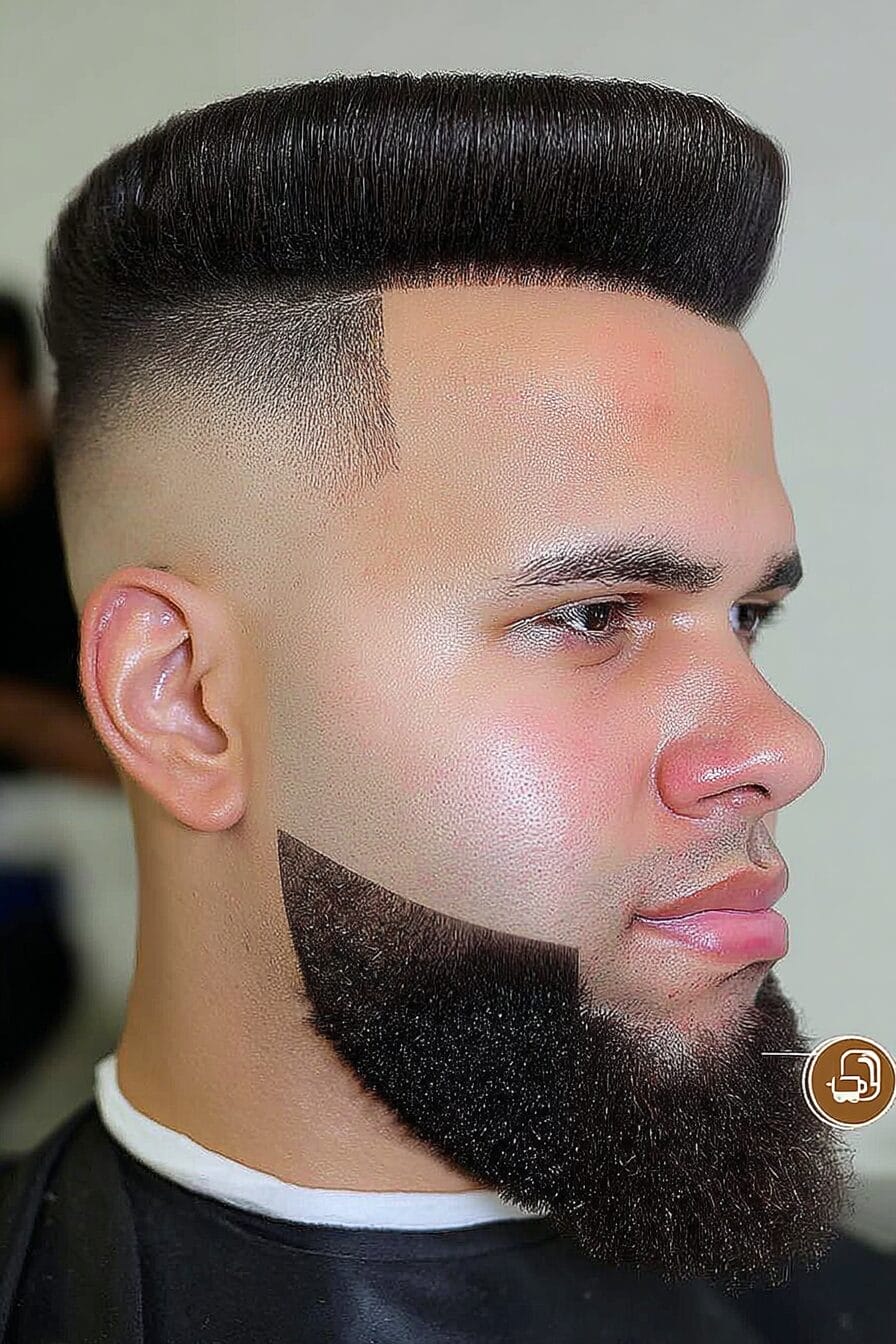
Professional Beard For Round Face
Round faces need one thing from a beard: vertical length. Every choice follows from that. Keep the cheeks and sides trimmed tight — guard 1 or 2 — and let the chin build downward two to three inches, creating a subtle V that stretches the face toward oval. It’s the same principle I use with haircuts for round faces: height and length, never width.
The mistakes to avoid are a full rounded beard, which doubles the roundness, and heavy width at the sideburns. Ducktail, extended goatee, and the square beard are your shortlist. Get the geometry right and the beard does quiet contouring work all day — jawline definition no gym session can give you.

Sleek Professional Beard
The sleek beard is a finish, not a shape — every hair lying flat and smooth in the same direction, no frizz, no flyaways, a low healthy sheen. For men with coarse or wavy growth it’s transformative, and it’s the look I prep for anyone going on camera, because beard frizz catches studio lighting like a halo.
The routine: wash, then a heated beard brush (or a blow-dryer on low over a boar-bristle brush) pulling downward while the hair is warm, then balm worked through to set it. Two extra minutes in the morning holds all day. Skip the heat on dry hair and go easy on product — shine should whisper, not gleam.


Explore More Beard Styles
🎬 8 BEARD GROWING MISTAKES YOU NEED TO AVOID with Matty Conrad
FAQs: Professional Beard Styles
How short should a professional beard be?
The safe range I work to is 3mm to 2 inches, and where you sit in it depends on your industry. Conservative fields — law, banking, healthcare — sit comfortably at 15mm and under, while creative and tech workplaces happily accept 2–3 inches if it’s shaped.
Length matters less than upkeep, though: a groomed 2-inch beard beats neglected stubble in any office on earth. My honest advice is to look at the most senior bearded man in your company and stay at or below his length until you’ve read the room.
Are beards acceptable in corporate environments?
Overwhelmingly yes — surveys now put acceptance of well-groomed beards at over 80% of workplaces, and the trend has only moved one direction in the twenty-plus years I’ve been grooming professionals. The qualifier is “well-groomed”: clean neckline, even length, no scruff phase on display Monday morning.
The exceptions are practical rather than cultural — food service, some healthcare roles, and jobs requiring a sealed respirator mask may restrict facial hair for safety or hygiene. Check your handbook, glance at what leadership wears, and when in doubt start with heavy stubble and grow from there.
How often should I trim my professional beard?
Match the frequency to the length. Stubble styles at 2–5mm need a full trimmer pass every other day — at that length even two days of growth shows. Short beards at 5–20mm hold for three to four days between passes, and fuller beards can stretch to weekly, provided you’re brushing and oiling daily in between.
On top of your home routine, book a barber every two to three weeks for the neckline, cheek lines, and shape — those are the parts that are genuinely hard to do evenly on yourself. Little and often always beats one big rescue trim.
What products keep a beard looking professional?
Three things cover 90% of it: beard oil, beard balm, and a boar-bristle brush. Oil goes on every morning — three or four drops worked into the skin underneath — to stop itch, flakes, and that dry wiry look. Balm adds light hold and keeps the shape through the day; the brush trains the hair flat and spreads the oil evenly.
Past two inches, add a dedicated beard wash and use it two or three times a week instead of daily shampoo. Avoid anything that leaves a wet-look shine — in an office, a beard should look healthy, not lacquered.
Can I have a professional beard with patchy growth?
Absolutely — you just choose a style that’s built from your strong zones instead of pretending the weak ones don’t exist. Most patchy growth is thin cheeks with a solid chin and moustache, which is exactly the map for a goatee, extended goatee, circle beard, or Balbo.
If you want all-over coverage, stay short: heavy stubble at 5–7mm disguises sparse patches far better than length, which just makes gaps gape wider. What kills patchy beards professionally isn’t the patches — it’s growing past them and hoping. Shape to your pattern and it reads as a deliberate style, because it is one.
Was this article helpful?
Find Your Perfect Beard Style
You’ve seen the options. Now find the one that actually suits YOUR face shape and growth pattern.
Take the Quiz →
Khamis Maiouf is a professional barber who graduated from Hinckley College in England with a Level 3 qualification in hairdressing. With over 20 years of experience, he is an award-winning barber who has mentored numerous students and styled thousands of clients. A recognised expert featured on StyleCraze (20M+ readers).
Credentials: Level 3 Hairdressing (Hinckley College, UK) • 20+ Years Professional Experience • Featured Expert on StyleCraze • Founder of Book of Barbering