
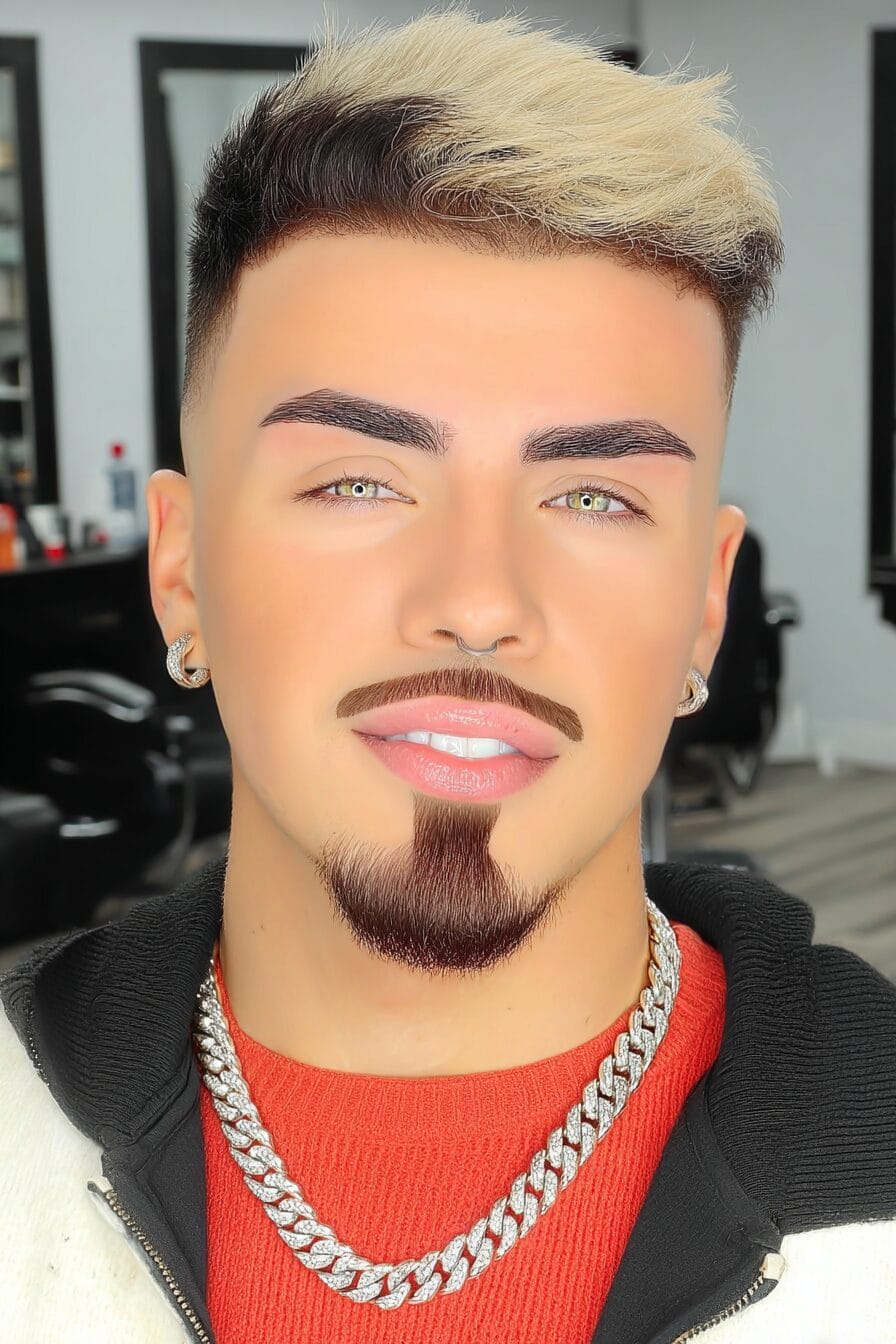
Half the men who sit in my chair and ask for a “goatee” are actually pointing at a photo of a Van Dyke — a mustache and a chin beard that never touch. That gap is the whole style. Get it crisp and you look like you made a decision; let it blur and it reads like a beard that gave up halfway. After two decades of shaping these, I can tell you the Van Dyke is quietly having a moment again, because the current direction in facial hair is intentional shape over bulk — tight edges, clean transitions, no wasted hair. A Van Dyke is exactly that, and it’s one of the few styles that looks better on men whose cheeks barely grow.
Want it looking barber-fresh? See my pick of a precise trimmer to line it up.
Key Takeaways
- A Van Dyke = separate mustache + chin beard — the visible gap between them is the style, not a mistake
- The gap fills in fast: touch up the disconnect and cheeks every 2–3 days or the whole look collapses into a circle beard
- Best friend of patchy cheeks — you shave off the weak zones and keep only where most men grow strongest
- The current trend favors tight edges with natural texture, not stencil-perfect lines — sharp, but still human
- Named after 17th-century painter Anthony van Dyck, who wore it in half his portraits
The Van Dyke is rooted in the goatee family — explore every goatee variation if you want a modern twist.
The Tools for a Precise Van Dyke
A Van Dyke lives on sharp, disconnected lines between the moustache and chin. You need precise styling and a trimmer you can trust for the detail.
Viking Revolution Beard Oil
A few drops a day softens the hair, kills the itch and stops the flakes. The cheapest habit that makes any beard look intentional.
Check it on Amazon →Viking Revolution Ultimate Beard Kit
Oil, balm, boar brush, comb and scissors in one box. If you’re serious about the look, this is the whole routine sorted — my pick for most men.
Check it on Amazon →Philips Norelco Beard Trimmer
Sharp cheek and neck lines are what separate “groomed” from “scruffy.” A trusted trimmer makes them easy to hold week to week.
Check it on Amazon →As an Amazon Associate, I earn from qualifying purchases — at no extra cost to you. Current price and availability are shown on Amazon.
What Is A Van Dyke Beard?
A Van Dyke is two pieces of facial hair that deliberately don’t connect: a mustache on top, a goatee on the chin, and clean-shaven skin everywhere else — cheeks, jawline, and the strip between lip and chin at the mouth corners. It’s named after Anthony van Dyck, the 17th-century Flemish painter who wore it in his self-portraits, and the reason it has survived four centuries is simple mechanics: it frames the mouth and sharpens the chin without needing a single hair on your cheeks.
That’s why I steer so many patchy-growth clients toward it. Most men grow strongest on the upper lip and chin and weakest on the cheeks — the Van Dyke keeps only the strong zones and shaves the evidence. You’re not hiding a weakness; you’re turning it into a design choice.

How To Shape A Van Dyke Beard
Here’s how I cut one in the shop, and how to do it at home. Grow everything out for 4–6 weeks first — you can’t shape hair that isn’t there. Then work in this order:
1. Set the goatee width. Hold your trimmer with no guard and cut two vertical lines down from just outside the corners of your mouth. Everything outside those lines comes off. 2. Shave the cheeks and neck clean — razor, not trimmer, so the skin looks finished. Keep the neckline about two fingers above your Adam’s apple. 3. Disconnect the mustache. Clear a small gap of bare skin at each corner of the mouth so the mustache and chin piece read as two separate shapes. 4. Trim to length — a #3 guard (10mm) is a safe starting point for both pieces.
My honest advice: pay a barber for the first shaping. Ask for “a Van Dyke — mustache and goatee kept separate, cheeks shaved clean.” Once the lines exist, maintaining them at home is a five-minute job. Re-shave the gap and cheeks every 2–3 days; stubble creeps in fast and blurs the disconnect that makes the style work.

Van Dyke vs Goatee: What’s The Difference?
This is the mix-up I correct most often in the chair. A true goatee is chin hair only — no mustache at all, like the billy goat it’s named after. A Van Dyke is a goatee plus a mustache, kept separate with visible skin between them.
The third style everyone confuses with both is the circle beard — that’s when the mustache and chin hair connect into one ring around the mouth. So the cheat sheet is: goatee = one element, Van Dyke = two separate elements, circle beard = one connected loop. When you’re booking a barber, use those exact words — “separate” or “connected” — and you’ll never walk out with the wrong one.

Classic Van Dyke Beard
The blueprint version: a chin piece around 1–2 inches long shaped to a soft point, a mustache trimmed neat just above the lip line, and a clean gap between them. Nothing exaggerated, nothing waxed — just proportion.
If you’re trying the style for the first time, start here. Keep the mustache on a #3 guard, scissor-trim the chin point by eye, and re-edge the cheeks twice a week. It gives you the full effect of the style with maybe ten minutes of weekly upkeep, and every other variation on this list is just this one with a dial turned up or down.

Short Van Dyke Style
Both elements clipped down to 5–10mm — that’s a #2 or #3 guard all over. The shape is still unmistakably Van Dyke, but it whispers instead of announcing itself, which is exactly why bankers, teachers and anyone with a conservative dress code ask me for this one.
It’s also the most forgiving low-maintenance version: one weekly pass with the trimmer holds the length, and at this scale small mistakes are invisible. Dense, coarse growers benefit most — short keeps thick hair from ballooning outward and looking heavy on the chin.

Long Van Dyke Beard
Let the chin piece run to 3–4 inches and keep the mustache substantial enough to balance it. This is the statement version — it lengthens the face dramatically, so it flatters round and square faces and can overwhelm an already long one.
Length changes the maintenance game. From about two inches, the point starts drying out and going wispy, so work 3–4 drops of beard oil through it daily and comb it downward to train the growth. Trim the point with scissors only — one over-eager pass with a trimmer takes months to undo at this length.

Van Dyke With Pointed Goatee
Here the chin piece is sculpted into a sharp triangular point — the version you see in Renaissance portraits and, honestly, on every actor cast as a duke. The point pulls the eye downward, which is why it’s my go-to for round faces that need vertical length and some angle.
The point doesn’t hold itself. Work a small amount of beard balm through the chin hair each morning and twist the tip between your fingers to set it. Keep the mustache medium — if it gets too heavy it fights the point for attention and the whole face looks busy.

Stubble Van Dyke
The full Van Dyke layout at just 2–4mm — a 0.5 or #1 guard. You keep the shape, the shadow and the jaw definition, with almost none of the commitment. This is the one I suggest when a client isn’t sure the style suits him: wear it at stubble length for two weeks, and if you like the shape, let it grow.
Short hair shows neglect faster than long hair, oddly enough. Run the trimmer over it every 3–4 days and keep the cheek edges shaved, or it stops reading as a style and starts reading as a lazy weekend. The slightly lived-in texture is right on trend — deliberate, but not polished to death.

Full Van Dyke Beard
The maximalist take: both the goatee and mustache grown dense and allowed to sit slightly wider than the textbook version — the chin piece can spread a finger’s width past the mouth corners — while the cheeks stay shaved and the two elements stay separate.
This suits men with strong jawlines and genuinely thick growth; on fine hair it just looks sparse spread over a bigger area. The trap to avoid is letting the wider goatee creep up toward the mustache until they merge — at that point you own a circle beard, not a Van Dyke. The wider the hair, the more religious the cheek shaving has to be.
Van Dyke With Handlebar Mustache
Pair the standard chin piece with a handlebar mustache — grown long past the mouth corners and curled upward with wax — and you get the full vintage-gentleman effect. It’s theatrical in the best way, and the contrast between the flamboyant top and the disciplined chin is what makes it work.
Be honest with yourself about the routine before committing: the handlebar alone needs 5–10 minutes of warming wax between your fingers and shaping each morning, plus 3–4 months of growth before the ends will curl at all. During the awkward middle phase, train the hairs sideways daily with a small comb. Barbers love clients who wear this one — it means they care.

Disconnected Van Dyke Style
Every Van Dyke is disconnected by definition — this version just turns the volume up, with as much as an inch of bare skin between mustache and chin piece instead of the usual few millimeters. All that negative space makes both shapes look deliberately placed, almost graphic.
It photographs beautifully on men with full lips or strong mouth definition, because the gap becomes a frame. The cost is upkeep: a wide gap shows regrowth within 48 hours, so this is an every-other-day razor commitment. I edge it with a single-blade detail trimmer first, then finish the gap with a razor for that clean-skin contrast.

Van Dyke With Soul Patch
Add a small tuft centered under the lower lip and you’ve got a three-piece composition — mustache, soul patch, goatee, all separated. The soul patch visually bridges the gap without closing it, which softens the starkness of a standard Van Dyke.
Keep the patch small and tight — a thumbnail-sized rectangle or triangle, clipped to the same length as the mustache. Let it sprawl and it merges into the chin piece, and the three-element effect is gone. There’s a reason this one has never left jazz clubs and recording studios: it signals precision and a bit of artistic intent at the same time.

Rounded Van Dyke Beard
Swap every point and corner for a curve: the chin piece finishes in a gentle U-shape, the mustache follows the natural arc of the lip, and all the edges are softened rather than squared. It’s the friendliest Van Dyke — same structure, none of the villain energy.
I shape this one for men with angular faces more than anyone else; the curves offset a hard jaw the way a pointed version would exaggerate it. It’s also the safest choice for client-facing jobs where a sculpted point might read as too much. Round the corners with scissors, not the trimmer — guards cut flat planes, and this style is all about avoiding them.

Angular Van Dyke Style
The opposite philosophy: straight lines and defined corners everywhere. The chin piece is squared or triangulated with ruler-straight edges, the mustache holds a crisp horizontal line, and the overall effect is architectural.
One warning from the current trend cycle: hyper-stencilled edges — the kind that look drawn on with a marker — are falling out of fashion fast. The version that still looks right is sharp but believable: clean corners, tight edges, hair that still looks like hair. Get the initial geometry cut by a barber, then hold the lines at home with a zero-gap detail trimmer every couple of days. If a line drifts, don’t chase it — chasing is how a goatee shrinks to a soul patch by Friday.

Van Dyke With Waxed Mustache
Keep the chin natural and put all the styling into the mustache — a firm-hold wax worked through it so it holds a defined horizontal shape, pointed straight out or angled slightly, without the full upward curl of a handlebar.
The texture contrast is the appeal: one groomed, sculptural element against one relaxed one, which feels much more current than styling both to death. The routine is genuinely short — a rice-grain amount of wax, warmed between finger and thumb, combed through in 2–3 minutes. Use a matte wax if you don’t want shine; the glossy Victorian look isn’t for everyone.

Natural Van Dyke Beard
This is where facial hair is heading right now: the Van Dyke framework with the polish dialed down. Edges are trimmed but not razored into hard lines, lengths vary a little the way hair actually grows, and the whole thing works with your growth pattern instead of against it.
It’s the best version for wavy and curly beard hair, which fights geometric shaping anyway — let the texture do the styling. Upkeep is a weekly scissor tidy and a cheek shave every three days or so; you’re maintaining a shape, not enforcing one. The line between “natural” and “neglected” is the cheeks — keep them clean and everything above reads as intentional.

Thick Van Dyke Style
Maximum density in both elements — a chin piece and mustache that are unmistakably full and heavy, for men whose growth can back it up. On the right beard genetics this projects presence like nothing else on this list; on thin growth it simply isn’t available, and that’s fine — pick the stubble or short version instead.
Thick hair needs thinning, which surprises people. Every few weeks I go through a heavy Van Dyke with thinning scissors to take out bulk while keeping the silhouette, otherwise the chin piece turns into a solid block. And watch the gap — dense growth closes it faster than fine hair does. Miss two shaves and you’ve accidentally grown a circle beard.

Van Dyke For Square Face
A square face already has width and corners, so the Van Dyke’s job is to add vertical length. Shape the chin piece into a downward triangle that extends below the chin, keep the mustache on the thinner side so it doesn’t add horizontal weight, and let the shaved cheeks slim the mid-face.
The geometry is simple: every millimeter of point below the chin visually stretches the face, and every millimeter of mustache width squares it back up. When I shape this in the shop I keep the goatee walls angled inward as they drop — a tapering shape, never a box, because a boxy goatee on a boxy jaw doubles the problem.

Extended Van Dyke Beard
The chin piece grown out to 4–6 inches — genuinely long — while the mustache and the clean cheeks stay in classic proportion. All the drama concentrates in that one hanging point, and it can be worn straight, loosely twisted, braided, or cinched with a small beard ring if you want the full statement.
At this length you’re maintaining hair, not just a shape: oil daily, comb morning and night, and a monthly scissor dusting on the ends to stop splitting. Budget six months to a year of growth to get there. This one isn’t for blending in, and the men who wear it know that — it’s the most-photographed style in my portfolio by a distance.

Van Dyke With Chevron Mustache
Swap the standard mustache for a chevron — thick, wide, angled slightly down over the top lip — and the whole style changes weight. The heavy top element reads instantly masculine, and against a tidy chin piece it creates a top-heavy contrast that flatters longer faces by adding horizontal balance.
Not sure what your face shape is? Our Face Shape Detector figures it out in 4 quick questions.
Give the mustache 6–8 weeks minimum before judging it — a chevron lives on density, and it looks scraggly right up until it suddenly doesn’t. Trim only the hairs crossing the lip line; the width and weight are the point.

Narrow Van Dyke Style
Everything pulled in tight: the chin piece confined to the center of the chin, the mustache stopping at the mouth corners, maximum bare skin everywhere else. The slimmed footprint elongates the face and keeps the style in proportion on smaller features, where a full-width Van Dyke can look borrowed from a bigger man.
It’s also the fastest version to maintain — less hair, fewer edges, a two-minute trim twice a week. The precision matters more, though: on a narrow shape, a wobbly line is immediately visible because there’s nothing around it to hide in. Use a small detail trimmer, not a full-size one, for the vertical edges.

Salt and Pepper Van Dyke
Gray coming through a Van Dyke isn’t something to fix — it’s a feature. The mix of dark and silver adds natural contrast that makes the shape look more expensive, and tone contrast is exactly what current grooming trends reward. Most men gray unevenly — mustache and chin at different rates — and that asymmetry gives the style depth you can’t fake.
Two care notes from the chair: gray hair is coarser and drier, so it drinks beard oil — use it daily or the silver turns dull and wiry. And if the color contrast feels too stark against your skin, shortening the style half a step evens the tone. Pairs naturally with salt and pepper hair up top.

Van Dyke With Pencil Mustache
The most delicate pairing on the list: a full chin piece under an ultra-thin pencil mustache riding just above the lip line. The deliberate imbalance — heavy below, whisper-thin above — is pure old-Hollywood, and on the right face it’s devastatingly sharp.
It’s also the highest-precision option here. A pencil mustache is maintained with a razor and a steady hand daily — there is no hiding a crooked line that thin. I shape the top edge first, following the natural lip line, then clean below it, and I tell every client the same thing: do it after a hot shower, in good light, never in a rush. Skip a day and it stops being a pencil.

Modern Van Dyke Beard
The contemporary cut of the classic: edges done with a precision trimmer, a subtle fade where the goatee meets the skin instead of a hard stop, and lengths that transition rather than jump. Today’s version is less about laser-drawn lines and more about blended sharpness — defined, but with the transitions softened so nothing looks stamped on.
This is what most of my under-35 clients mean when they ask for a Van Dyke, whether they know the name or not. Ask your barber for “a Van Dyke with faded edges — tight but blended, nothing harsh.” It sits perfectly alongside a skin fade or taper, and the upkeep is a barber visit every 2–3 weeks with light edging at home between.

Professional Van Dyke Style
The version engineered to pass in any boardroom: both elements at a uniform medium length — #2 to #3 guard — no dramatic point, no wax, no wide gap, every line quietly clean. It has character without ever becoming a talking point, which is precisely the brief for corporate life.
Consistency is the entire trick. A professional Van Dyke that’s immaculate Monday and fuzzy Thursday defeats its own purpose, so the routine is small but daily: thirty seconds checking the gap and cheek lines each morning, a proper trim once a week. I’ve shaped these for lawyers, surgeons and headteachers — it’s the proof that facial hair and a serious job were never actually in conflict.

Sculpted Van Dyke Beard
The show piece: every edge deliberately placed, often with stepped lengths or subtle asymmetry, cut the way you’d expect from a barber competition. This is facial hair as craft, and it genuinely needs a professional to establish — the layered transitions can’t be freestyled with a bathroom mirror and hope.
My honest counsel: keep the sculpting on the believable side of the line. The over-carved look — perfect stencil curves on the cheeks, edges sharper than the tools that made them — has tipped into costume territory and is dating fast. Sculpted should mean considered, not manufactured. Expect a barber visit every two weeks and a few minutes of daily edge patrol to keep it gallery-ready.

Van Dyke With Fade
The most requested combination in my shop right now: a Van Dyke that flows out of a faded haircut. The sideburns taper from hair length down to bare skin, the cheeks stay clean, and the eye travels from haircut to beard in one unbroken line. It turns two separate grooming decisions into one designed look.
The catch is synchronization — the fade grows out in about three weeks while the Van Dyke needs edging every few days, so book the barber every 2–3 weeks and maintain the beard lines yourself between visits. Ask for “a taper on the sideburns blending into shaved cheeks, Van Dyke kept separate at the mouth.” Any barber who cuts fades will know exactly where to take it.

Explore More Beard Styles
FAQs: Van Dyke Beard Styles
How long does it take to grow a Van Dyke beard?
Plan for 4–8 weeks of growth before the first proper shaping. You need roughly half an inch of length on the chin and lip before a shape will hold, and because you’re only growing the mouth-and-chin zone — not full cheeks — it comes in faster than almost any full beard style.
Fast growers can be shapeable in three weeks; slower or finer growth needs the full two months. My rule in the shop: don’t let anyone near it with a trimmer until you can pinch the chin hair between two fingers. Shaping too early just means shaving off your progress.
What face shape suits a Van Dyke best?
Round and square faces get the most out of it. The vertical shape and pointed chin piece add length to a round face, while the curves and clean cheeks soften a heavy square jaw. Oval faces can wear any variation on this page without adjustment.
The one caution is long, narrow faces — a pointed or extended Van Dyke stretches them further, so keep the chin piece short and consider a rounded bottom instead of a point. With those tweaks, I’ve fitted a Van Dyke to essentially every face shape that’s sat in my chair.
How do I maintain a Van Dyke beard?
Three habits keep it alive: shave the cheeks and the gap every 2–3 days, trim the mustache and goatee to length weekly — scissors for the shaping, trimmer for the bulk — and work a few drops of beard oil through it daily so the hair stays soft and sits flat.
The cheek-and-gap shaving is the non-negotiable one. The entire style is built on visible separation, and 72 hours of stubble is enough to blur a Van Dyke into a scruffy circle beard. Total time cost once the shape exists: about five minutes every other day.
Can I grow a Van Dyke with patchy facial hair?
Yes — it’s honestly the best style in existence for patchy growth. The Van Dyke only requires hair on the upper lip and chin, which are the two zones where nearly every man grows strongest, and it shaves away the cheeks where patchiness usually lives.
If even the lip or chin has thin spots, keep the length shorter — short hair reads denser than long hair stretched over gaps. I’ve put Van Dykes on men who spent years believing they “couldn’t grow a beard.” They can — just not on their cheeks, and this style makes that irrelevant.
What’s the difference between a Van Dyke and a goatee?
A true goatee is chin hair only, with no mustache at all. A Van Dyke adds a mustache but keeps it separated from the chin hair by a strip of bare skin. The style everyone mislabels as a “goatee” — mustache and chin hair joined in a ring around the mouth — is actually a circle beard. Remember it as: goatee is one element, Van Dyke is two separate elements, circle beard is one connected loop. Use those words with your barber and you’ll get exactly the style you pictured.
Was this article helpful?
Find Your Perfect Beard Style
You’ve seen the options. Now find the one that actually suits YOUR face shape and growth pattern.
Take the Quiz →
Khamis Maiouf is a professional barber who graduated from Hinckley College in England with a Level 3 qualification in hairdressing. With over 20 years of experience, he is an award-winning barber who has mentored numerous students and styled thousands of clients. A recognised expert featured on StyleCraze (20M+ readers).
Credentials: Level 3 Hairdressing (Hinckley College, UK) • 20+ Years Professional Experience • Featured Expert on StyleCraze • Founder of Book of Barbering