
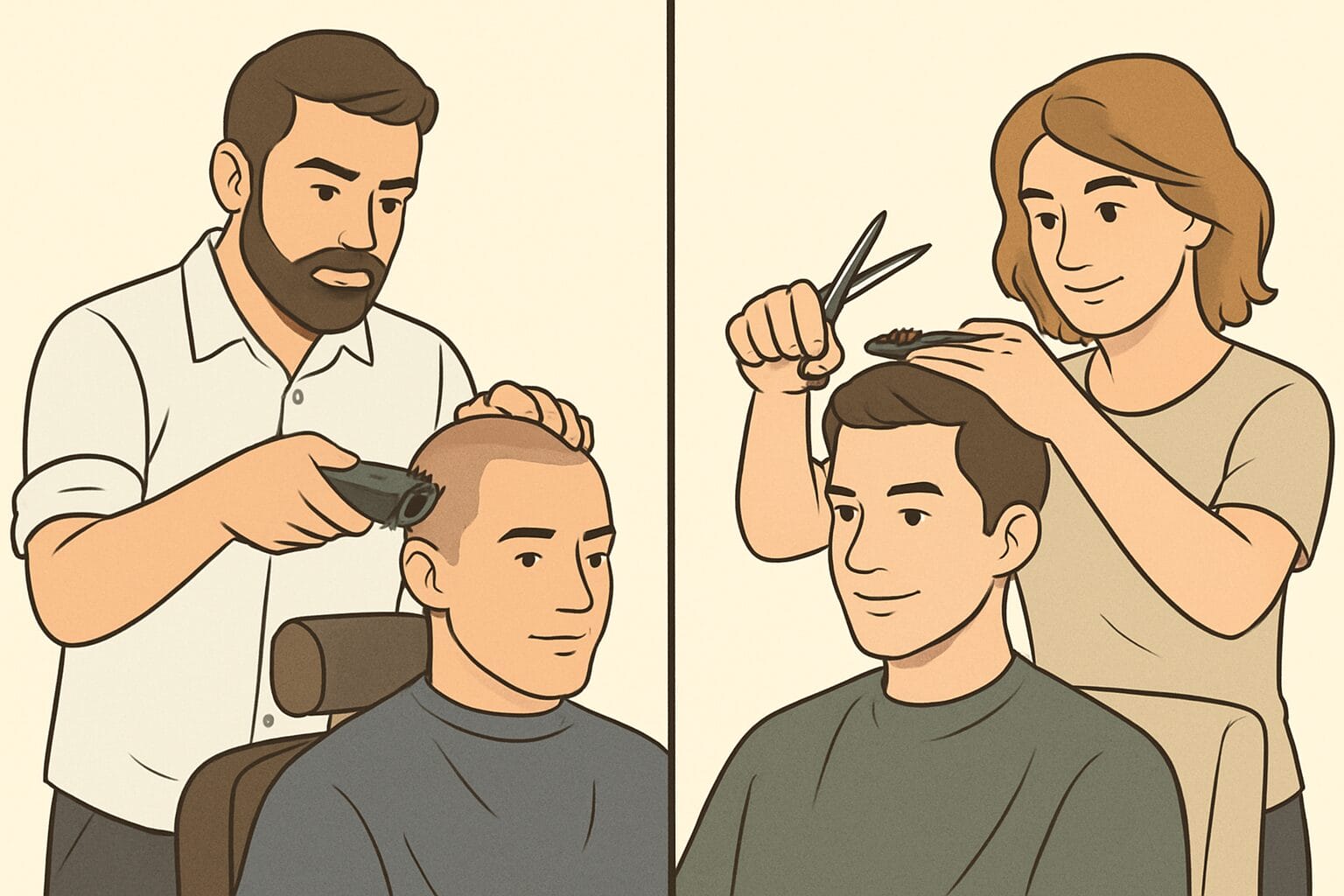
Here is what I wish every client knew before walking into a barbershop for the first time: the barber matters more than the haircut. You can walk in with the perfect reference photo, explain exactly what you want, and still leave disappointed if the person holding the clippers does not have the skill, the attentiveness, or the understanding of your hair to execute it. Conversely, a good barber can take a vague request like “just tidy it up” and give you the best cut you have had in years.
After 20+ years behind the chair, I have worked alongside brilliant barbers and mediocre ones, trained apprentices who became exceptional, and watched talented cutters lose clients through laziness. I know what separates a barber worth building a relationship with from one who is just going through the motions. This guide gives you that insider perspective — how to find, evaluate, and choose a barber who will consistently deliver the cut you want.
If you are still working out what to ask for once you are in the chair, our how to ask for a haircut guide covers the communication side in detail.
Not sure which style suits you best? Our Haircut Finder Quiz matches you with the right cut based on your face shape and hair type — takes 60 seconds.
Key Takeaways
- The barber matters more than the haircut – a skilled barber can work with vague requests, while a poor one can ruin even a perfect reference photo
- Research online reviews and Instagram portfolios before visiting, but personal recommendations from people with great haircuts are the most reliable indicator
- Visit the shop before booking – check for Barbicide jars, professional-grade clippers, and how barbers interact with clients in the chair
- Give a new barber three visits before deciding – the first cut is an introduction, and true consistency shows by the third appointment
- Watch for red flags like rushing cuts under 15 minutes, skipping consultations, phone use mid-cut, and not showing you the finished result in a mirror
Barber vs. Stylist: Know the Difference
Before you start searching, understand the distinction between a barber and a hairstylist. They are not the same profession, and the difference affects what you can expect.
A barber is licensed specifically for men’s grooming. Barber training covers clipper work, fading, tapering, straight razor shaving, beard shaping, and the specific cutting techniques that men’s hair requires.
In most regions, barbers hold a separate licence from cosmetologists and are the only professionals legally permitted to use a straight razor on clients. If you want a fade, a razor-clean neckline, or a hot towel shave, a barber is who you need.
A hairstylist (or cosmetologist) trains across a broader range of services — colouring, perming, chemical treatments, women’s cutting — but typically receives less focused education on clipper fades, razor work, and the precision techniques that define modern men’s barbering. Some stylists are excellent with men’s hair, but the specialisation runs in the barber’s favour for most standard men’s cuts.
If your style involves fading, tapering, or any straight razor work, choose a barber. If you want colour services or a longer, layered style, a salon stylist may be better equipped.
Research Before You Visit

A little research beforehand saves you from the trial-and-error approach of walking into random shops and hoping for the best. Here is where to look and what to look for.
Word of Mouth

The most reliable recommendation comes from someone whose haircut you actually admire. If a mate, colleague, or family member consistently has a sharp cut, ask them who does it. A personal recommendation from someone with similar hair to yours is worth more than a hundred online reviews, because you can see the results in person and ask specific questions about the experience.
Online Reviews

Google and Yelp reviews give you a broad picture of a shop’s consistency. Look for patterns rather than individual reviews — a single five-star or one-star review tells you very little.
If 80% of reviews mention the same barber by name with positive comments about attention to detail, that is a strong signal. Pay particular attention to reviews that mention specific services like fades, beard work, or handling difficult hair types. Ignore reviews that only comment on the shop’s atmosphere or waiting time — those do not tell you about the quality of the cut.

Instagram is the modern barber’s portfolio. Search hashtags like #[yourcity]barber, #[yourcity]barbershop, or #[yourcity]fade to find barbers working in your area.
A barber who regularly posts their work is confident in it — and the photos let you judge the quality of their fades, blends, line-ups, and beard work before you ever sit in the chair. Look for consistency across posts, not just a few standout photos. Also check whether they post work on hair types similar to yours.
Booking Availability

This is a counterintuitive but reliable indicator: the best barbers are usually the hardest to book. If a barber has same-day walk-in availability every day of the week, that tells you something about demand.
If another barber is booked out three to five days in advance, that tells you something too. A waiting list is not a guarantee of quality, but it is a strong signal that existing clients are loyal — and loyalty in barbering means consistent results.
Visit the Shop First

If possible, visit the barbershop before booking your first appointment. You can learn more from a five-minute walk-through than from an hour of online research.
Cleanliness

This is non-negotiable. Look for Barbicide jars at each station — those blue-filled containers where combs and tools are disinfected between clients.
Fresh capes or covers should be used for every client, not the same one draped over the back of the chair from the previous cut. The floor should be swept regularly throughout the day, not piled with hair from the morning’s clients. Clean mirrors, organised stations, and a well-maintained shop reflect a barber who takes their work seriously.
Tool Quality

Glance at the tools on the station. Professional-grade clippers — Wahl Magic Clip, Andis Master, BaByliss FX870 — are a good sign.
Cheap, entry-level clippers suggest a barber who has not invested in their craft. You should also see a variety of tools: multiple clipper sizes, trimmers for detail work, shears, thinning shears, a straight razor or shavette, and a blow dryer. A barber who only owns one set of clippers is limited in what they can deliver.
Atmosphere and Client Interaction

Watch how the barbers interact with the clients in the chair. Are they engaged in the cut or distracted by their phone?
Do they check with the client during the cut or just power through without asking? A good barber communicates — they confirm what the client wants, check progress, and make adjustments. A barbershop where the barbers seem focused, present, and enjoying their work is a barbershop worth trying.
Red Flags on Your First Appointment

Your first visit is an audition — for both of you. The barber is assessing your hair and the client is assessing the barber. Here are the warning signs that should make you hesitate before rebooking.
- The first question is “What number?” — A barber who jumps straight to guard numbers without asking about your lifestyle, how you style your hair, or what you liked and disliked about your last cut is operating on autopilot. Guard numbers are a tool, not a consultation. A good barber asks questions first and reaches for the clippers second.
- They rush the cut — A standard men’s cut takes 20-30 minutes. A fade with a beard trim takes 30-45 minutes. If a barber is consistently finishing cuts in under 15 minutes, corners are being cut along with the hair. Speed is not the same as efficiency.
- They are distracted by their phone — Scrolling between cuts is fine. Checking messages mid-fade is not. A blade near your skin requires full attention, and a barber who cannot put the phone down while working is not giving you the focus your cut deserves.
- Their own grooming is poor — I tell apprentices this on day one: you are a walking advertisement for your skill. A barber with an unkempt beard, a grown-out haircut, or dirty nails is telling you what level of care they apply to their work. If they do not care about their own appearance, question how much they will care about yours.
- They do not use a mirror at the end — A barber who finishes the cut and removes the cape without showing you the back and sides in a hand mirror is either too rushed or not confident enough in the result to let you inspect it. You should always be shown the final cut from all angles before you leave the chair.
Green Flags That Signal a Good Barber

These are the habits and behaviours I see in every barber I respect. They are not flashy, but they are the foundation of consistently excellent work.
- They start with a consultation — even a brief one. Before touching the clippers, they ask what you want, look at your hair type and growth patterns, and discuss what is achievable. This takes 60-90 seconds and is the difference between a cut designed for you and a generic cut applied to you.
- They ask about your lifestyle — “How much time do you spend styling in the morning?” and “What do you do for work?” are not small talk. They determine whether a high-maintenance fade or a low-maintenance textured crop is the right recommendation. A barber who understands your daily routine gives you a cut that works in real life, not just in the mirror at the shop.
- They use both scissors and clippers — A barber who relies solely on clippers is limited. Scissors are essential for texturising, point cutting, and blending the top into the sides with precision. A barber who reaches for the shears to refine the top after using clippers on the sides demonstrates a broader skill set.
- They ask for feedback mid-cut — “How is the length on top looking?” or “Do you want me to take the sides shorter?” shows a barber who treats the cut as a collaboration rather than a unilateral decision. It also prevents the disappointment of seeing the final result and wishing you had spoken up earlier.
- They clean up details at the end — The last two minutes of a cut are where good barbers separate from average ones. Cleaning the neckline with a razor or trimmer, checking for symmetry, removing stray hairs around the ears, and dusting the neck are finishing touches that show pride in the work.
Hair Type Matching

Not every barber is equally skilled with every hair type. This is not a criticism — it is a reality of training and experience. A barber who spends most of their day cutting straight, fine Caucasian hair may not have the expertise to cut coily, Afro-textured hair to the same standard, and vice versa.
If you have curly or coily hair, look for a barber who specifically showcases this type of work on their Instagram or website. Curly hair requires different cutting techniques — cutting dry versus wet, understanding shrinkage, knowing how curl patterns change at different lengths. A barber experienced with curly textures will ask whether you style your curls or wear them natural, and will cut accordingly.
If you have fine or thinning hair, seek a barber who understands how to create volume and density through cutting technique rather than simply buzzing it short. Techniques like point cutting, texturising, and strategic layering require specific knowledge.
A barber who recommends a crew cut for every thinning client may not have the full toolkit. For help identifying the right style for thinning hair, our what haircut should I get guide covers recommendations by hair type and face shape.
If you have thick, coarse hair, you need a barber comfortable with thinning shears and with adjusting clipper techniques for density. Thick hair needs weight removed strategically — not just length taken off the top.
Walk-In vs. Appointment

Walk-in barbershops have their place — they are convenient, usually affordable, and fine for straightforward cuts like buzz cuts and basic trims. But if you want a specific barber or a style that requires skill and attention, book an appointment.
An appointment means the barber has allocated time specifically for you. There is no pressure to rush because the waiting area is full, and no risk of getting whichever barber happens to be free when you walk in. Most quality barbershops now use online booking systems — Booksy, Fresha, or Square Appointments are common — which makes scheduling simple.
As I mentioned earlier, a barber who is consistently booked out several days in advance is a barber in demand. That demand exists because their existing clients keep coming back.
If the barber you want has no appointments available for a week, that is a good sign — not a reason to look elsewhere. Book in advance and plan your haircut schedule around their availability. Our haircut frequency guide can help you plan the right interval for your style.
The Three-Visit Rule

I tell every new client the same thing: give me three visits before you decide whether I am your barber. Here is why.
The first visit is an introduction. The barber is learning your head — the shape of your skull, where your cowlicks sit, how your hairline behaves, how thick or fine your hair is, and what your expectations look like in practice rather than in conversation. Even a good barber may not deliver their best work on the first visit because they are working with unknowns.
The second visit builds on the first. The barber now knows your hair, remembers what worked and what needed adjusting, and can refine the cut with that knowledge. This is where the relationship between barber and client starts to form — and where the cut starts to feel personalised rather than generic.
By the third visit, the barber knows your head as well as they can without years of history. If the cut is not right by visit three, it is fair to conclude that this barber is not the right match for you.
But judging after a single appointment — especially with a skilled barber who simply had not learned your head yet — is premature. Patience in the early visits pays off in years of consistently excellent cuts.
Building the Relationship and Tipping

The best barber-client relationships last years, sometimes decades. They work because both sides invest in them.
From your side, be consistent. Book regularly, show up on time, communicate clearly about what you want, and give honest feedback — both positive and constructive.
If something is not right, say so during the cut rather than complaining afterward. A good barber wants to know, and they will adjust. From the barber’s side, consistency means remembering your preferences, adapting to changes in your hair over time, and proactively suggesting adjustments as trends shift or your hair changes with age.
Tipping is standard in barbering. The generally accepted range is 15-20% of the service cost (use our barber tip calculator to work out the exact amount). For a £30 ($40) cut, that means £4.50-£6 ($6-$8).
For exceptional service, tip above 20%. If a barber has gone above and beyond — fitted you in on short notice, spent extra time on a difficult style, or given you advice that genuinely improved your grooming routine — tipping generously is the clearest way to show appreciation. Cash is always preferred, as it goes directly to the barber without processing fees.
When to Switch Barbers

Loyalty is important, but it is not unconditional. There are legitimate reasons to move on, and recognising them prevents you from settling for subpar cuts out of habit.
If the quality has dropped consistently over several visits — not just one off day — it is time to reassess. Barbers can become complacent with long-term clients, falling into a routine rather than giving each cut fresh attention. If you have communicated your concerns and the quality has not improved, switching is reasonable.
If your barber is no longer keeping up with techniques you want — you are asking for skin fades and they are delivering shadow fades, or you want textured work and they only do scissor-over-comb — there may be a skill mismatch. This is not a failure on either side; it simply means your needs have outgrown what that barber offers.
If the shop’s hygiene standards have slipped, leave without hesitation. Dirty tools, reused capes, and unclean stations are not minor issues — they are health risks. No haircut is worth an infection.
Price Expectations by Service

Knowing what to expect prevents sticker shock and helps you budget for regular visits. Prices vary by location, but these ranges cover most markets.
- Standard haircut (scissors and clippers) ranges from £15-£35 ($20-$45) at most barbershops, with urban and high-end shops at the upper end.
- Skin fade or precision fade typically adds £5-£15 ($5-$20) on top of the standard cut price due to the additional time and skill required.
- Beard trim and shape runs £10-£20 ($10-$25) as a standalone service or is often included with a haircut at a reduced rate.
- Hot towel shave costs £15-£30 ($20-$40) for a full straight razor shave with prep and aftercare.
- Haircut and beard combo — the most common full-service booking — typically ranges from £25-£50 ($35-$65) depending on complexity.
- Neckline cleanup between cuts is usually £5-£10 ($5-$15) and takes 10-15 minutes — a cost-effective way to extend the life of a faded cut.
Price and quality do not always correlate directly, but consistently cheap haircuts usually reflect either low overhead (which is fine) or low skill investment (which is not). A barber charging £25 ($35) who delivers a consistently sharp fade is better value than a barber charging £15 ($20) who gives you a cut you need to fix within a week. If you want to understand the guard numbers your barber uses and what they mean for your cut, our haircut numbers guide breaks down every guard with measurements.
Questions to Ask a New Barber

Walking into a new barbershop can feel awkward, especially if you are not sure what to say beyond “short back and sides.” Brushing up on haircut terminology beforehand helps you speak the barber’s language. Here are questions that help you assess the barber and communicate your needs clearly.
Ask “What would you recommend for my face shape and hair type?” — A barber who gives a thoughtful, specific answer demonstrates both knowledge and attentiveness. One who shrugs and asks what number you want is not engaged.
Ask “How long have you been cutting?” — Experience matters, but it is not everything. A barber with three years of focused training and passion can outperform one with twenty years of autopilot. What you are listening for is enthusiasm and pride in the answer, not just a number.
Ask “Do you have experience with [your specific hair type]?” — There is no shame in asking, and a confident barber will answer honestly. If they specialise in a different hair type, they will often recommend a colleague who is a better match.
Ask “Can I see photos of your recent work?” — If they do not have an Instagram presence, most barbers have photos on their phone. A barber who is proud of their work is happy to show it. For those who are still working out what to ask for, our how to become a barber guide gives insight into what training and skill development looks like from the barber’s perspective — useful context for understanding what separates good from great.
🎬 How to Choose Barber Scissors and Scissor Maintenance
Frequently Asked Questions
How do I find a good barber in my area?
Start with personal recommendations from men whose haircuts you admire. Supplement with Google and Yelp reviews, looking for consistent positive mentions of specific barbers by name.
Search Instagram using hashtags like #[yourcity]barber to see portfolios of local barbers’ work. The best barbers are usually booked several days in advance — availability that is too open can indicate low demand.
What questions should I ask a new barber?
Ask what they would recommend for your face shape and hair type, whether they have experience with your specific hair texture, and if you can see photos of recent work. These three questions tell you whether the barber is engaged, experienced, and confident. A good barber will also ask you questions — about your lifestyle, styling routine, and what you liked or disliked about previous cuts.
How do you know if a barber is good?
A good barber consults before cutting, uses both scissors and clippers, checks in with you during the cut, pays attention to detail in the finishing (neckline, ears, symmetry), and shows you the result from all angles before you leave. Consistent positive reviews, a portfolio of quality work, and a full appointment book are external indicators. Give a new barber three visits before making a final judgement.
How much should you tip a barber?
The standard range is 15-20% of the service price. For a £30 cut, tip £4.50-£6.
Tip above 20% for exceptional service — short-notice bookings, extra time spent, or advice that genuinely helped your grooming routine. Cash tips are preferred as they go directly to the barber without processing deductions.
Should I bring a picture to the barber?
Yes — a reference photo is one of the most helpful things you can bring. It eliminates ambiguity and gives the barber a clear visual target.
Bring two to three photos if possible: the front, the side, and ideally someone with a similar hair type to yours. A good barber will look at the photo, assess whether it is achievable with your hair, and tell you honestly if adjustments are needed.
Was this article helpful?
Ready to Find Your Perfect Cut?
You’ve read about the styles. Now find the one that fits YOUR face shape, hair type, and lifestyle.

Khamis Maiouf is a professional barber who graduated from Hinckley College in England with a Level 3 qualification in hairdressing. With over 20 years of experience, he is an award-winning barber who has mentored numerous students and styled thousands of clients. A recognised expert featured on StyleCraze (20M+ readers).
Credentials: Level 3 Hairdressing (Hinckley College, UK) • 20+ Years Professional Experience • Featured Expert on StyleCraze • Founder of Book of Barbering