

Every day, guys sit down in my chair and say “just make it look good” — then wonder why the result isn’t what they pictured. After 20+ years behind the chair, I can tell you the single biggest reason for haircut disappointments: not knowing your numbers.
Clipper guard numbers are the universal language between you and your barber. Each number represents an exact hair length, from a near-bald #0 to a full-inch #8. Master these 9 numbers and you’ll walk into any barbershop knowing exactly how to get the men’s haircut you actually want.
Key Takeaways
- Clipper guard numbers range from #0 (1/16 inch) to #8 (1 inch), each increasing by 1/8 inch
- The most popular combination is a #2 on the sides with a #4 on top for a clean, professional look
- Half-guard sizes and the clipper lever give barbers 18+ precise lengths for seamless fades
- Always start with a longer guard — you can go shorter, but you can’t add hair back
- Guard numbers are universal across brands, but the physical guards aren’t interchangeable
Understanding Clipper Guard Numbers
Clipper guard numbers follow a straightforward system where each number represents a specific cutting length.
The numbering starts at #0 (no guard) which cuts nearly to the skin at 1/16 inch (1.5mm), then increases by 1/8 inch increments. A #1 guard leaves 1/8 inch (3mm), a #2 leaves 1/4 inch (6mm), and so on up to #8 at 1 inch (25mm). Most barbershops use this universal system across all major clipper brands.
Think of guard numbers like measuring cups in cooking – they provide consistent, repeatable results every time. Without guards, even experienced barbers would struggle to maintain uniform length across different areas of your head. The plastic or metal attachments snap onto your clipper blades, creating a precise gap between the cutting blade and your scalp.
Now let’s examine each guard size in detail to help you choose the right lengths.
Complete Clipper Guard Length Chart
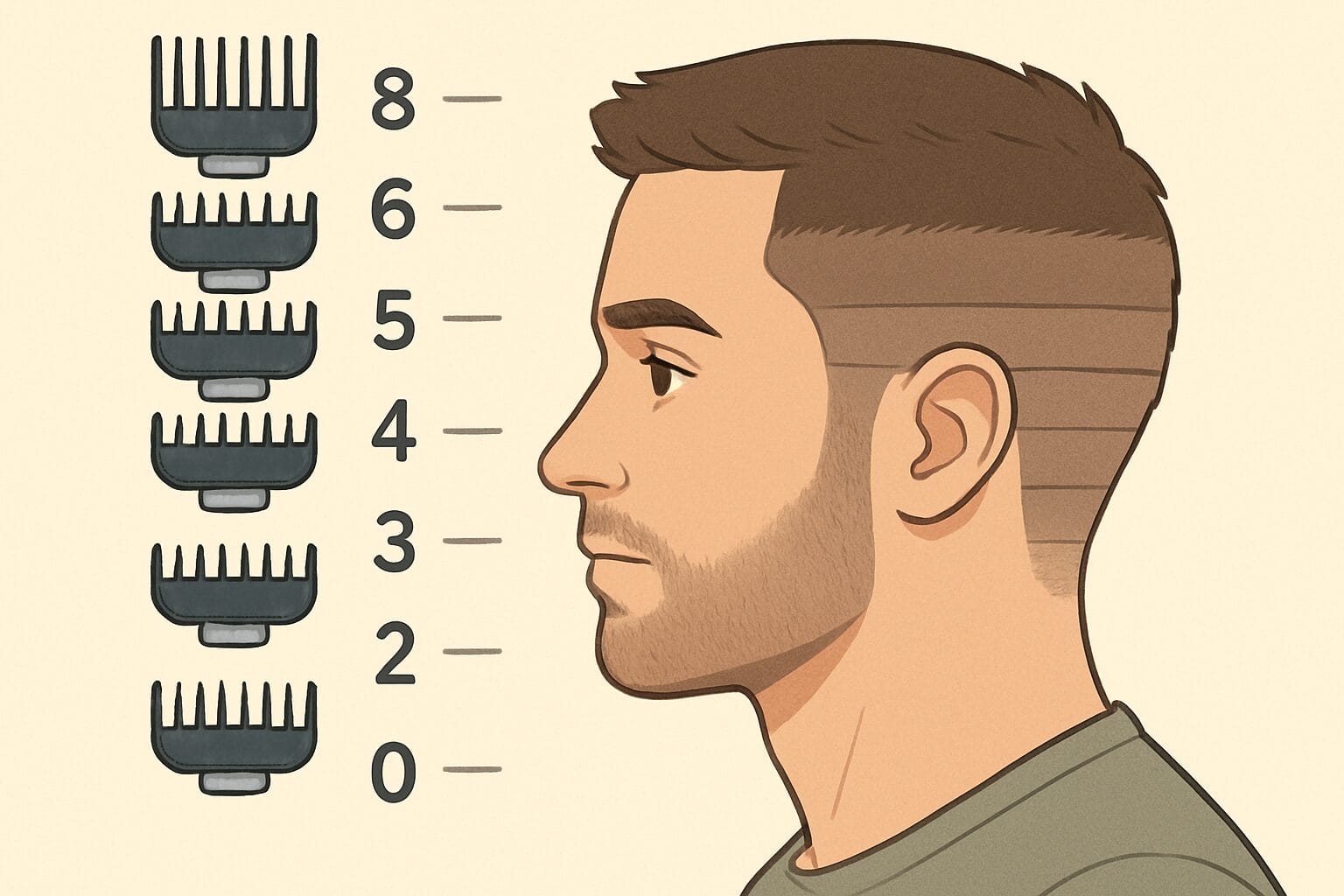
Having a complete reference chart helps you visualize exactly how short or long each guard will cut.
Guard #0 to #2

These shortest guards create the foundation for fades and ultra-short buzz cuts. A #0 (1/16 inch or 1.5mm) gives an almost bald look, while #1 (1/8 inch or 3mm) leaves slight stubble visible.
The #2 guard (1/4 inch or 6mm) is the sweet spot for many men, providing a clean military-style length that still shows scalp. These guards work best for creating the “fade” portion of modern haircuts where hair gradually transitions from skin to longer lengths.
Guard #3 to #5

Medium-length guards offer more coverage while maintaining that fresh-cut appearance. The #3 (3/8 inch or 10mm) and #4 (1/2 inch or 13mm) guards are barbershop favorites for all-over cuts that require minimal styling.
A #5 guard (5/8 inch or 16mm) provides enough length to show hair texture and natural growth patterns. These lengths work excellently for professional men who want low maintenance but don’t want the military look of shorter guards.
Guard #6 to #8

Longer guards maintain substantial hair length while ensuring evenness across your entire head. The #6 (3/4 inch or 19mm) and #7 (7/8 inch or 22mm) guards leave enough hair for slight styling flexibility.
The #8 guard (1 inch or 25mm) is the longest standard attachment, perfect for trimming without drastically changing your hairstyle. These guards work best on the top sections of layered cuts or for maintaining longer buzz cuts that require some texture.
Understanding these measurements helps you request exactly what you want at the barbershop.
Half-Guard Sizes and the Lever System
Most guys don’t realize their barber has access to far more than just 9 lengths. Between the standard whole-number guards, half-sizes like #0.5, #1.5, and #2.5 fill the gaps. I rely on these in-between guards daily — a #1.5 gives me that precise middle ground between a #1 and #2 that makes or breaks a clean fade.
Then there’s the clipper lever — that small switch on the side of every professional clipper. When the lever is closed (pushed all the way up), the blade cuts at its shortest setting. Opening the lever (pushing it down) extends the blade slightly, adding roughly half a guard length to whatever guard is attached.
This means a #2 guard with an open lever cuts closer to a #2.5 length. A #3 guard with a closed lever cuts at a true #3, but open it and you’re at about #3.5. Between standard guards, half-guards, and lever positions, a skilled barber has 18+ distinct length options to use with their clippers.
If you’re doing fades at home, the lever is your best friend. Start with the lever closed for the tightest cut at the neckline, then gradually open it as you move up the head before switching to the next guard size. This creates those seamless, barbershop-quality transitions that make a fade look professionally done.
Choosing the Right Guard Number

Selecting appropriate guard numbers depends on your desired style and where on your head they’ll be used.
For Fades and Tapers

Creating smooth fades requires multiple guard sizes working in harmony. Start with a #0 or #1 at the bottom edges, then progress through #2 and #3 guards as you move up the sides.
The key is overlapping each guard’s cutting area slightly, using a rocking motion to blend the lengths. Most barbers use at least three different guards for a proper fade, sometimes incorporating half-sizes or adjusting the clipper lever for even smoother transitions.
For All-Over Cuts

Single-guard cuts offer simplicity and consistency, making them perfect for DIY maintenance. Most men find #3 or #4 guards ideal for an all-over cut that looks neat without being too short.
Consider your hair density and growth patterns when selecting – thicker hair often looks better with slightly longer guards like #5 or #6. Fine or thinning hair may benefit from shorter lengths like #2 or #3 that create the appearance of fuller coverage.
Let’s explore the most requested guard combinations that create popular modern styles.
Popular Haircut Combinations

Certain guard number combinations have become barbershop standards because they create balanced, flattering proportions.
The classic “2 on the sides, 4 on top” remains incredibly popular for good reason. This combination provides clean, professional sides while maintaining enough length on top for basic styling. Another favorite is the “skin fade with 3 on top” which offers maximum contrast and a sharp, modern appearance.
For those wanting more length, try “3 on sides, 6 on top” which allows for textured styling on top while keeping sides neat. The “1-2-3 fade” creates a gradual blend from bottom to top, perfect for guys who want a subtle fade without harsh lines.
💡 Pro Tip
Ask your barber to write down the exact guard numbers used for your haircut on their business card. This simple record eliminates guesswork at your next appointment and helps you maintain consistency even when visiting different barbers. I’ve found this especially helpful for clients who travel frequently or move to new cities.
Knowing these combinations helps you communicate more effectively with your barber.
How to Communicate with Your Barber

Clear communication using guard numbers prevents misunderstandings and ensures you get exactly what you want.
Not sure what your face shape is? Our Face Shape Detector figures it out in 4 quick questions.
Instead of vague haircut terms like “short” or “medium,” specify exact numbers: “I’d like a #2 on the sides, faded down to skin at the edges, with a #5 on top.” This precision gives your barber a clear roadmap and shows you understand what you’re asking for.
Don’t hesitate to ask questions if your barber suggests different numbers than you expected. Sometimes factors like your head shape, hair growth patterns, or cowlicks might require slight adjustments. A good barber will explain why they’re recommending specific guards and how it will affect your final look.
If you’re unsure about length, always start longer – you can always go shorter, but you can’t add hair back. Many barbers will show you the guard before using it, giving you a chance to confirm or adjust your choice.
Proper guard maintenance ensures these measurements stay accurate over time.
Guard Maintenance and Care

Well-maintained guards provide consistent cuts while damaged ones can snag hair and create uneven lengths.
Clean your guards after every use by removing hair buildup and washing with warm soapy water. Dry them completely to prevent rust on metal guards or warping on plastic ones. Store guards in their original case or a designated container where they won’t get crushed or bent.
⚠️ Common Mistake
Using worn or damaged guards is the fastest way to ruin a haircut. Cracked guards can pinch and pull hair, while bent teeth create uneven cutting lengths.
Check guards before each use for chips, cracks, or bent teeth. Replace any damaged guards immediately – the $5-10 cost is nothing compared to fixing a botched haircut.
Regular inspection and replacement keeps your cuts looking professional whether at home or in the barbershop.
Ready to Find Your Perfect Cut?
You’ve read about the styles. Now find the one that fits YOUR face shape, hair type, and lifestyle.
🎬 Basic Mens Haircut | Step by Step Guide
Clipper Guard Sizes by Brand
One question I get all the time: “Do guard numbers mean the same thing on every clipper?” The short answer is yes — a #4 guard leaves half an inch of hair whether it’s on a Wahl, Andis, or Oster clipper. The numbering system is industry-standard.
Where brands differ is in guard construction and fit. Wahl’s color-coded plastic guards are the most common in barbershops and home kits. Andis guards tend to run slightly thicker and snap on with a firmer click. Oster’s premium metal guards are built for heavy daily use and maintain their shape longer than plastic alternatives.
The important thing to know: guards from one brand don’t always fit another brand’s clippers. If you buy a Wahl clipper, stick with Wahl guards. Mixing brands can create a loose fit that causes the guard to pop off mid-cut — I’ve seen it happen more times than I can count. For a deeper look at compatibility and sizing, check our complete guide to clipper guard sizes.
FAQs
What’s the difference between clipper numbers and actual hair length?
Clipper numbers indicate the guard size, while actual hair length is what remains after cutting. For example, a #4 guard leaves 1/2 inch of hair on your head. The guard number represents the space between the clipper blade and your scalp, determining how much hair stays behind.
Can I use different guard numbers on myself at home?
Yes, but start with simple all-over cuts using a single guard before attempting fades or multiple lengths. Practice your technique on longer guards first since mistakes are less noticeable.
Use mirrors to check all angles and work in good lighting. Consider having someone help with hard-to-reach areas like the back of your head.
Which clipper guard numbers work best for different hair types?
Thick, coarse hair often looks best with #3 or longer guards to avoid a bristly appearance. Fine or thinning hair may benefit from #2 or #3 guards that create an illusion of density.
Curly hair typically needs longer guards (#4 and up) to account for spring-back when dry. Always consider your natural growth patterns when selecting guards.
What number should I ask my barber for?
The right number depends on your desired style and hair type. For a clean, professional look, ask for a #2 on the sides with a #4 on top — it’s the most requested combination in barbershops. If you want a shorter military-style cut, go with a #1 or #2 all over. For more length and styling options, ask for a #3 on the sides with scissors on top. Always bring a reference photo and tell your barber both the top length and side length you want — specific numbers eliminate guesswork.
Are clipper guard sizes universal across brands?
The numbering system is universal — a #4 guard always means half an inch of hair regardless of brand. However, the physical guards themselves aren’t interchangeable between brands. Wahl guards won’t snap onto Andis clippers properly, and using ill-fitting guards can cause them to pop off during a cut. Stick with the same brand for both your clippers and guards to ensure a secure fit.
Was this article helpful?

Khamis Maiouf is a professional barber who graduated from Hinckley College in England with a Level 3 qualification in hairdressing. With over 20 years of experience, he is an award-winning barber who has mentored numerous students and styled thousands of clients. A recognised expert featured on StyleCraze (20M+ readers).
Credentials: Level 3 Hairdressing (Hinckley College, UK) • 20+ Years Professional Experience • Featured Expert on StyleCraze • Founder of Book of Barbering