
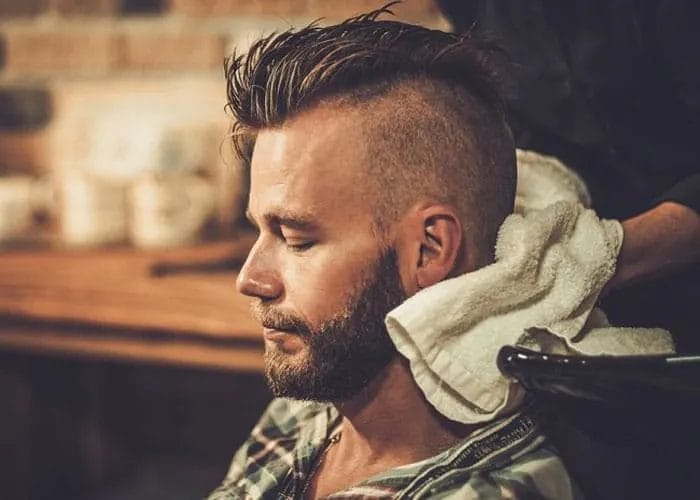
Walking into a barbershop shouldn’t feel like entering a foreign country where you don’t speak the language. Yet most men struggle with barber terminology, nodding along while secretly hoping they’ll get what they pictured.
After 20+ years behind the chair, I’ve seen countless miscommunications turn great haircut potential into disappointment. The good news? Learning just a handful of key terms transforms you from confused customer to confident client.
Key Takeaways
- Fades go to skin, tapers don’t — this is the #1 term most men get wrong at the barbershop
- Guard numbers (#1–#8) correspond to exact lengths from 1/8 inch to 1 inch — use them instead of saying “short”
- Know your neckline preference (blocked, rounded, or tapered) before you sit down — barbers will ask
- Bring a reference photo AND use the right terms together for the best results
- When in doubt, ask your barber to explain what they’re about to do before they start cutting
Once you know the terminology, the 25 most popular haircuts for men become much easier to ask for at the chair.
The Basics You Need To Know
Barber terminology isn’t complicated once you understand the building blocks. Every haircut discussion revolves around length, blend, and shape.
Think of it like ordering coffee – once you know what “macchiato” means, you stop accidentally ordering espresso with whipped cream. Same principle applies here.
Essential Haircut Terms
Fade vs Taper
A fade gradually disappears to skin, starting from zero. Picture a gradient that vanishes completely at the bottom.
A taper keeps hair visible throughout, just getting progressively shorter. The key difference?
Fades show skin, tapers don’t. Most “fades” people request are actually tapers.
Guard Numbers And Lengths
Guard numbers translate directly to length: #1 equals 1/8 inch, #2 equals 1/4 inch, and so on. Each number up doubles the previous length.
A #4 leaves 1/2 inch of hair, while #8 leaves a full inch. Most barbershops stop at #8, though some carry longer guards for specialty cuts.
Texture And Weight
Texture refers to your hair’s natural pattern – straight, wavy, curly, or coily. Weight describes thickness and density.
When barbers talk about “removing weight,” they’re thinning bulk without changing length. This creates movement and prevents that helmet-like appearance heavy hair can develop.
Neckline Shapes
Blocked necklines create a straight line across the neck – clean but requires frequent touch-ups. Rounded follows your natural hairline with softer corners.
Tapered necklines gradually blend into the neck, lasting longest between cuts. Your head shape and maintenance preference determine the best choice.
Disconnected vs Connected
Connected styles blend smoothly from sides to top with no harsh lines. Think classic businessman cuts where everything flows together.
Disconnected cuts feature an intentional contrast – like an undercut where sides and top are completely separate. This creates a bold, modern look requiring precise maintenance.
Fade Types Explained
Knowing that you want a “fade” is step one. But there are six main types, and telling your barber which one you mean is the difference between leaving happy and leaving surprised.
Low Fade
The blend starts just above the ear, keeping most of the sides visible. This is the most conservative fade — works in any office environment. I recommend it to guys who want clean sides without anything too dramatic.
Mid Fade
Starts roughly at the temple line, splitting the difference between subtle and bold. This is the most requested fade in my chair because it suits almost every face shape and hair type.
High Fade
Begins well above the temples, removing most of the side hair. Creates strong contrast with the top. Popular with guys who want a sharper, more defined look — but it needs more frequent barber visits to stay clean.
Skin Fade (Bald Fade)
Blends all the way down to bare skin. The most dramatic option and the hardest to execute well. When a client asks for this, I always confirm: “You want skin showing at the bottom?” Because there’s no putting that hair back once it’s gone.
Drop Fade
Instead of following a straight line around the head, the fade “drops” lower behind the ear. This creates a curved, natural-looking line that flows with your head shape. Works especially well on guys with rounder heads.
Temple Fade
A minimal fade that only cleans up the area around the temples and sideburns. Everything else stays. I use this on clients who want a polished look without committing to a full fade — it’s the entry-level option.
Advanced Terminology
Point Cutting And Texturizing
Point cutting uses vertical snips to create soft, feathered edges. This technique adds movement and removes harsh lines.
Texturizing encompasses several methods – thinning shears, razor work, or notching. Each creates different effects from subtle movement to dramatic texture.
🧠 Expert Advice
Most clients don’t realize “thin it out” can mean five different techniques. Thinning shears remove bulk evenly, while razor thinning creates wispy ends.
Point cutting adds choppy texture, slicing creates movement, and notching makes dramatic texture. Specify whether you want less weight, more movement, or actual visible texture – your barber will choose the right technique.
Line Up And Edge Work
Line ups create crisp hairlines using clippers or razors – essential for fades and many modern styles. Natural edges follow your existing hairline.
Edge work includes sideburns, around ears, and neckline details. These finishing touches separate average cuts from exceptional ones.
Popular Haircut Style Terms
Beyond the technical terms, you should know the names of the most common styles. When you can say “I want a textured French crop with a mid fade” instead of “something short on the sides,” your barber knows exactly where to start.
Buzz Cut
One uniform length all over, done entirely with clippers. The easiest cut to maintain and the hardest to mess up. Usually done with a #2 or #3 guard. It’s not the most exciting style, but there’s a reason military guys and busy professionals keep coming back to it.
Crew Cut
Short on the sides with slightly more length on top that tapers toward the front. Think classic Americana. The difference from a buzz cut is that the top has more shape and direction, usually brushed forward or to one side.
For more on this timeless style and its many variations, see our full crew cut guide.
Undercut
Short or shaved sides with a sharp contrast to the longer top. The “disconnected” look — there’s no blending between the two lengths. It’s bold and works best when you’re willing to style the top daily with product.
Pompadour
Volume swept upward and back from the forehead. Made famous by Elvis and still going strong. Modern pompadours usually pair with a fade on the sides instead of the original slicked-back look. You need at least 3–4 inches on top and a good pomade.
Not sure what your face shape is? Our Face Shape Detector figures it out in 4 quick questions.
Quiff
Similar to a pompadour but with more texture and a looser finish. The hair lifts at the front and falls naturally rather than being slicked tight. Easier to maintain day-to-day and looks less “produced” than a full pompadour.
French Crop
Short, textured top with a straight fringe across the forehead. One of the most low-maintenance styles that still looks intentional. Pairs well with any fade type and works on most hair textures. I cut more of these than almost any other style right now.
Side Part
A classic — hair combed to one side with a defined part line. Can be done with a natural part or a hard part (razor-cut line). This is the default “professional” look and works in any formal setting.
Comb Over Fade
A side part with a fade on the shorter side. The modern version of the classic comb over — nothing like the comb-over-a-bald-spot stereotype. It’s clean, versatile, and one of the top five most requested styles in my shop.
Slick Back
All the hair brushed straight back off the forehead. Requires strong-hold product and works best with straight or wavy hair. The sides can be faded, tapered, or left longer for a more classic look.
High and Tight
Military-origin cut with very short (usually skin-faded) sides and back, with a short top. Clean, no-nonsense, and zero maintenance. If you want to spend less than 30 seconds on your hair every morning, this is it.
Check out our guide to fading hair if you want to understand exactly how your barber creates these transitions.
Practical Application
Combine terms for precise communication: “Number 2 fade, disconnected top with textured fringe” paints a clear picture. Use photos as backup, but terms ensure accuracy.
Start appointments by confirming terminology with your barber. A quick “When you say fade, does that mean to skin?” prevents surprises.
Common Misconceptions
⚠️ Common Mistake
Saying “short on sides, long on top” without specifics could mean anything from a conservative taper to an extreme undercut. One client’s “short” is another’s “medium.” Instead, use guard numbers for sides (#2 or #3) and inch measurements for top (2-3 inches). Add blend preference – “faded,” “tapered,” or “disconnected” – and you’ll get exactly what you envision.
Ready to Find Your Perfect Cut?
You’ve read about the styles. Now find the one that fits YOUR face shape, hair type, and lifestyle.
🎬 Basic Mens Haircut | Step by Step Tutorial
FAQs
What’s the difference between a barber cut and salon cut terminology?
Barbers use clipper-focused terms like “fade,” “taper,” and guard numbers. Salons emphasize scissor work with terms like “layers,” “graduation,” and “texturizing.”
Some overlap exists, but barbers generally speak in precise measurements while stylists describe shapes and movement. Both understand basic length terms.
How do I describe the haircut I want if I don’t know all the terms?
Start with what you know: how short on sides, how much length on top, and whether you want everything blended. Bring reference photos and point out specific elements you like.
Good barbers translate your descriptions into technical execution. Don’t hesitate to ask what they’re planning before they start cutting.
Why do different barbers interpret the same terms differently?
Regional differences and training backgrounds create variations. A “low fade” in New York might be called a “taper” in Texas. Military barbers define “high and tight” differently than civilian shops.
Always clarify specifics with your current barber rather than assuming universal definitions. Once you find common language, stick with it.
What do the numbers mean at the barbershop?
The numbers refer to clipper guard sizes. Each number equals a specific hair length: #1 is 1/8 inch (3mm), #2 is 1/4 inch (6mm), #3 is 3/8 inch (10mm), #4 is 1/2 inch (13mm), all the way up to #8 at 1 inch (25mm)
. When your barber asks “what number on the sides?” they’re asking which guard to use. Lower number = shorter hair.
What is the difference between a fade and a taper?
A fade blends the hair all the way down to skin — you can see scalp at the shortest point. A taper gradually gets shorter but always leaves some hair visible. Most guys who ask for a “fade” actually want a taper.
The easiest way to tell your barber: if you want skin showing, ask for a fade. If you want hair throughout, ask for a taper.
Related Guides
Was this article helpful?

Khamis Maiouf is a professional barber who graduated from Hinckley College in England with a Level 3 qualification in hairdressing. With over 20 years of experience, he is an award-winning barber who has mentored numerous students and styled thousands of clients. A recognised expert featured on StyleCraze (20M+ readers).
Credentials: Level 3 Hairdressing (Hinckley College, UK) • 20+ Years Professional Experience • Featured Expert on StyleCraze • Founder of Book of Barbering