

— Award-Winning Barber · 20+ Years Experience · Level 3 Qualified
Ask most guys what a good beard looks like and you’ll get five variations of the same answer — a neat full beard, a beardstache, maybe a stubble fade. Then you have the clients who show up in my chair asking for a beard shaped like a monkey tail, a checkerboard carved into their cheeks, or twelve inches of trained wizard point. Those are the ones I remember.
Weird beard styles have gone from novelty photos to a legit corner of men’s grooming — social media rewards them, competition circuits refine them, and the “textured natural” direction dominating beards right now has quietly made asymmetry, patchiness, and personality more acceptable than any polished full beard. What follows is my honest breakdown of 20 unconventional styles — which are wearable, which are competition-only, how to grow them, and how to ask your barber so nobody panics.
Key Takeaways
Want to know which beard style actually works with your face? Take the Beard Style Quiz — 5 questions to find out.
- Weird beard styles range from everyday-wearable (monkey tail, braided beard) to competition-only showpieces (sculptures, themed designs).
- Many unconventional styles require months of growth and professional shaping to execute properly.
- Beard competitions like the World Beard and Moustache Championships have elevated weird beards from jokes to legitimate art forms.
- Strong-hold products, beard wax, and sometimes wire frameworks are essential for maintaining structural weird beard shapes.
- Social media has made weird beard styles more popular than ever—the monkey tail alone generated millions of views.
For something more conventional, the classic goatee styles still turn heads without going full weird.
For something more conventional, the classic goatee styles still turn heads without going full weird.
Tools to Pull Off a Bold Beard
An unusual beard only works if it’s well-kept — messy reads as accident, sharp reads as intentional. Here’s what keeps a statement beard looking deliberate.
Viking Revolution Beard Oil
A few drops a day softens the hair, kills the itch and stops the flakes. The cheapest habit that makes any beard look intentional.
Check it on Amazon →Viking Revolution Ultimate Beard Kit
Oil, balm, boar brush, comb and scissors in one box. If you’re serious about the look, this is the whole routine sorted — my pick for most men.
Check it on Amazon →Philips Norelco Beard Trimmer
Sharp cheek and neck lines are what separate “groomed” from “scruffy.” A trusted trimmer makes them easy to hold week to week.
Check it on Amazon →As an Amazon Associate, I earn from qualifying purchases — at no extra cost to you. Current price and availability are shown on Amazon.
Weird Beards at Competitions: Where the Art Gets Real
If you think unusual beards live only on Instagram, spend an afternoon at a live event. The World Beard and Moustache Championships and the National Beard and Moustache Championships pull hundreds of competitors, and the gap between what you see online and what walks on stage is night and day.
Every year the categories tighten. Natural full beard, styled goatee, imperial, Musketeer, sideburns freestyle — each has its own rules on shape, product, and length. Freestyle is the one that gets the cameras: full beards trained into antlers, spirals, dolphins, dragons, ships. Current NBMC rules let you use styling aids like waxes, gels and hairspray — but no rope, wire, or lumber holding the shape up. That constraint is why the freestyle winners are almost always barbers or hairstylists by trade; they know how to build structure from product alone.
Local charity events (Movember meetups, small-town whisker contests) are the easiest way in. You don’t need a two-foot beard to enter — most events have short-beard, mustache-only, and “partial beard” brackets. The community is friendlier than any barbershop I’ve worked in.
What Makes A Beard Style “Weird”?
A weird beard isn’t a messy beard — that’s the first thing I tell guys asking about this. What makes any of the styles below actually work is precision. If a monkey tail’s line is uneven, it reads as a shaving mistake. If a checkerboard isn’t perfectly gridded, it looks like a rash.
The working definition I use in the shop: a weird beard deliberately breaks one of the four “normal” rules — symmetry (asymmetric beard, monkey tail), continuity (disconnected patches, forked devil), color (rainbow, two-tone) or shape (wizard point, sculpted animal, geometric carving). One rule broken cleanly, everything else tight. That’s the formula that separates “bold” from “accident.”
Everything below has either passed through my chair or a competitor friend’s. I’ve noted realistic length ranges, product needs, and how likely each style is to fly at a normal office job — because that’s the question every client actually asks. If you want the broader landscape first, our full types of beard guide covers the conventional side.

Should You Try An Unusual Beard Style?
Honestly — maybe. The two questions I make guys sit with before booking a weird beard appointment are: how much time can you give it every morning, and are you ready to explain it a dozen times a day? Nothing kills a bold beard faster than a client who wanted attention but got tired of the attention after a week.
The other filter is growth quality. Weird beards depend on the base being dense enough to shape. If you’ve got patchy cheeks, styles that need a continuous line — monkey tail, spiral braid, forked devil — will look thin. Patchy guys are actually great candidates for the textured natural direction, where gaps become personality, or for geometric patterns and disconnected patches, where the gaps are the point.
Corporate guy testing the waters? Start with something reversible: a two-tone with temporary color rinse, an asymmetric trim you can level out in one visit, or a slight forked chin. Not sure which shape your face suits at all? Run our face shape detector first — it’ll tell you whether long-and-pointed or wide-and-carved sits better on you.
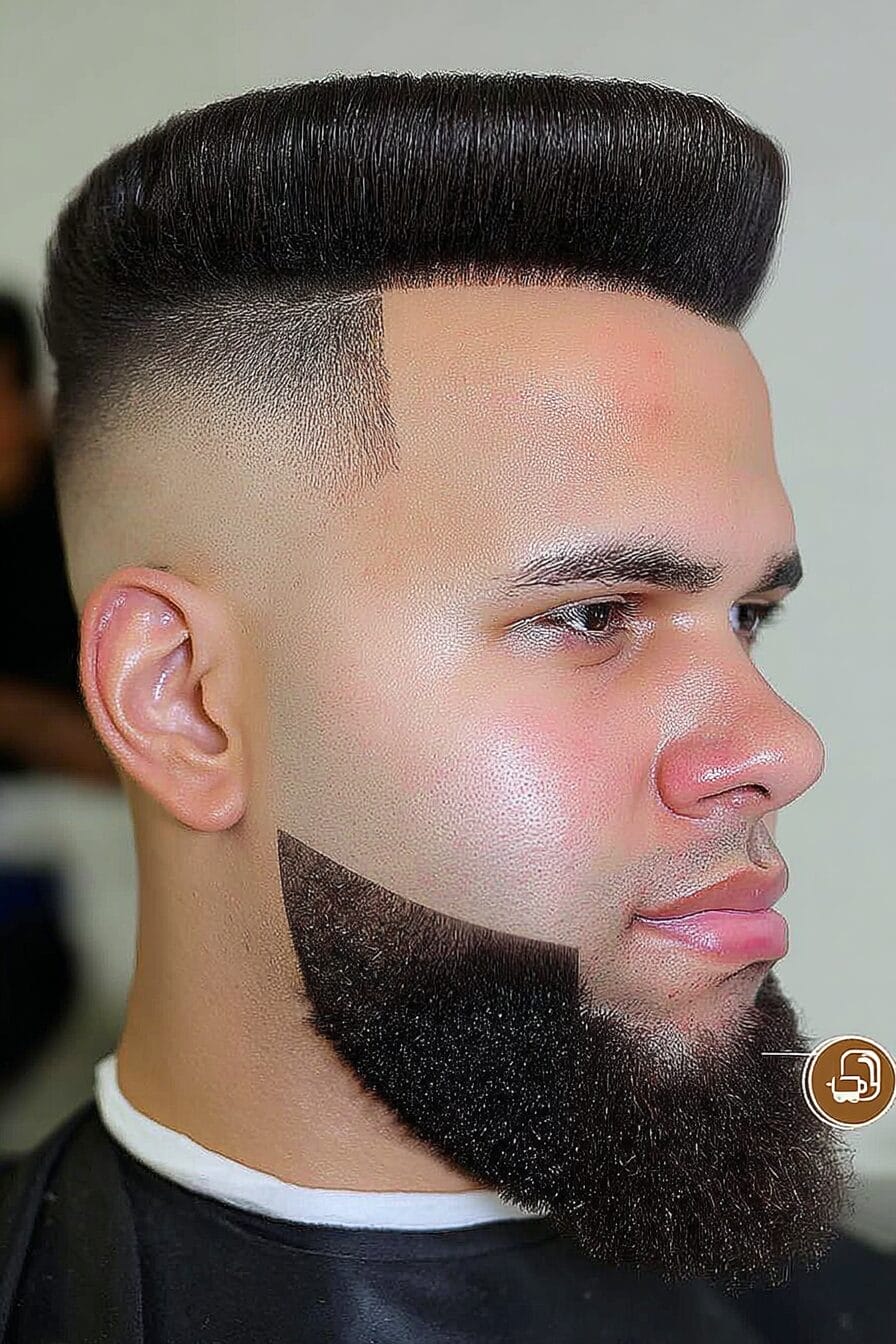
How To Pull Off A Weird Beard
Four things separate a weird beard that works from one that looks like a mistake.
One — grow the base out fully before cutting anything strange into it. Even a monkey tail, which most people picture as a shaving job, reads much better cut down from a 4-to-6-inch full beard. Density matters more than length.
Two — get it shaped by a barber the first time. I’ve had clients come in after DIY attempts and fixing a botched cheek line takes weeks of regrowth. Book an hour, bring reference photos, let a pro carve the master lines. Home maintenance after that is easy — a good pair of detail scissors, a #0 or #0.5 guard for touch-ups, and a small mirror.
Three — buy real product. Strong-hold beard wax (Honest Amish Original or Fisticuffs Strong Hold are my two go-to’s in the shop), a firm hairspray for competition shapes, and a small bristle brush for training the hair down. Skip cheap “beard gel” — it flakes and ruins photos.
Four — protect the base. A weird beard is still a beard. Wash it 2-3 times a week with a proper beard wash, oil it every day, and get it re-shaped every 3-5 days. Every style below assumes you’re doing this. Skip the maintenance and every look reads accidental.

Monkey Tail Beard
The monkey tail is still the most-requested weird style in my shop — it exploded around 2020 and never fully died. The shape is a single continuous line: sideburn on one side, down the cheek, curves under the chin, up the other cheek, wraps around the mouth like a mustache, ends at the opposite corner. From the front it looks like a tail wrapped across the face.
Guard-wise, I take everything else to a #0 or clean-shaven and leave the tail at whatever length the client already had — usually 1 to 3 inches. The real trick is the taper: the tail should be thickest at the sideburn and gradually thin toward the mustache end, or the shape reads flat. Ask your barber for “a monkey tail beard, tapered” — the word “tapered” is what stops it looking like a poorly shaved neck line.
Wearable at most creative jobs, weekend-only at most corporate ones. Takes 5-10 minutes of morning grooming — comb into shape, brush a light beard oil through, done. Clients usually keep it 2-4 weeks before resetting or letting it grow back into a full beard.

Reverse Goatee Style
The reverse goatee inverts the classic: instead of hair on the chin with shaved cheeks, you shave the chin and grow the cheeks and mustache. It looks like a mustache that dropped down onto the jawline. Semi-common in the ’90s alt-rock scene, back now with the anti-goatee texture-first trend.
Needs a decent cheek beard to work — patchy cheeks make this look like a shaving accident. I use a #2 or #3 guard across the cheeks and jawline, then take the chin down to bare skin with a straight razor. The tricky part is where the chin shave meets the jaw — go too far up and you lose the frame, too far down and it reads as two disconnected patches.
Ask for “a reverse goatee — cheeks and mustache stay, chin shaved to skin, jawline stays defined.” Costs about the same as a beard trim, but block an extra 15 minutes because the linework matters. Grows out into a normal beard in about three weeks if you decide to bail.

Spiral Braided Beard
The spiral is the entry-level braided beard: one single braid twisted so it corkscrews from the chin down, held at the tip with a small elastic or metal bead. Needs at least 4-5 inches of chin length to look like an actual spiral rather than a stubby twist.
Prep matters more than the braid itself. Wash the beard the night before, sleep on it damp, and it’ll braid smoother in the morning. Use a wide-tooth comb to detangle from the tip up, work a nickel-sized drop of beard oil through, then braid slowly — a spiral needs an even tight twist or the corkscrew turns lopsided. Finish with a light hairspray to lock the shape.
This is one of the few weird styles that’s genuinely office-friendly if you commit to it — reads “craftsman” more than “costume,” especially paired with a full mustache and a clean neckline. For more variations see our braided beard guide. Redo the braid every morning; slept-in braids always look messy on day two.

Two-Tone Split Beard
The two-tone splits the beard vertically down the middle and colors each half a different shade — natural on one side, dyed on the other, or two contrasting dyes. Photographers love the symmetry, which is why it went viral. It’s much rarer in real life because the maintenance is brutal.
For a soft version I use a semi-permanent beard color (Just for Men Mustache & Beard, or a Blackbeard for Men marker for one-off events). Apply with a thin brush, tape a line down the center chin to protect the natural side, leave 5-10 minutes, rinse. Lasts through 4-6 washes.
Permanent versions need a real hairdresser, gloves, and about an hour. Expect the split line to blur as new growth comes in — you’re re-touching every 3 weeks. Best for guys who genuinely enjoy the process. Want the look just for one photo shoot or Halloween? Stick with temporary product and skip the commitment.

Lightning Bolt Beard Design
The lightning bolt is a shaved pattern — one clean zigzag carved into a full cheek beard. It works because it’s simple. Guys usually request it after seeing a matching bolt on a fade haircut and wanting the beard to line up.
Needs a dense cheek beard of at least 3-4 weeks’ growth. I use a T-blade trimmer without a guard, mark the bolt shape lightly with a white eyeliner pencil first, then carve in one continuous line — no restarts, because a second stroke never lines up with the first. Sit the bolt high on the cheek, above the jawline, so it doesn’t distort when the client talks.
Lasts about a week before the shaved lines fill in. Most clients come back every 5-7 days for a re-carve. If you like this look, our lightning bolt haircuts guide covers matching hair designs.
Octopus Tentacle Beard
The octopus tentacle isn’t a single style — it’s a family of shapes where the chin beard is split and braided into multiple tapered points that curl outward like tentacles. Four to six braids is standard. This is a competition beard, not an everyday one.
You need serious length — at least 8 inches of chin hair to get any real curl. Braid tightly, then dip the ends into hot beard wax (I melt a small tin over a mug of hot water), curl the tips manually while the wax is warm, and let them cool into the curl. Result holds for a full day; sleeping in it destroys it.
Setup takes 30-45 minutes. This is a photo-shoot, wedding, or festival beard. If you want tentacles for a regular weekend, dial it back to two braided points — that variation is called a forked-braid and is genuinely wearable.

Asymmetric Beard Style
The asymmetric beard breaks the mirror rule: one side is a different length, shape or style from the other. The version I see most often now is a full beard on one side and a fade-to-skin on the other, meeting at a hard vertical line at the chin.
Guard combo I use most: #4 or #5 on the “full” side, faded down through #2, #1, #0.5 to skin on the other. The vertical dividing line runs from the corner of the mouth down to the jaw. Only works if the underlying growth is symmetrical — a naturally patchy beard makes the faded side look accidental.
Ask for “asymmetric beard — full on the [left/right] side, fade to skin on the other, hard line down the middle.” Wearable in creative fields; also grows out cleanly into a normal beard if you get bored. Reshape every 10-14 days.

Polka Dot Beard Pattern
Polka dots are pure competition. Small circles of clean-shaven skin cut into an otherwise full beard, usually 5-7 dots arranged in a pattern. It looks like reverse chicken pox — and it’s meant to be strange.
Method is the same every time: dense full beard, at least 6 weeks of growth. Draw the dots with a white eyeliner pencil first — I use a small coin as a template for consistency. Shave each dot clean with a small straight razor and a fresh blade. Whole session runs about 45 minutes.
Nobody wears this to work. It’s a photo, a competition category, or a one-off. Grows back in 3-5 days. Include it if you’re building a portfolio; skip it if you want a beard for actual life.

Zigzag Shaped Beard
Zigzag is the neckline version of the lightning bolt — instead of the beard ending in a straight or curved line under the chin, it ends in a series of sharp Vs. Reads bold from any angle and it’s the most office-passable of the carved designs.
I use a T-blade trimmer, mark the V-points with a light eyeliner, then cut a continuous zigzag from ear to ear. Points should be small — a quarter-inch tall — or the shape looks cartoonish. Neckline stays clean, so the zigzag reads as intentional rather than a growth pattern.
Ask for “zigzag beard neckline — small points, ear to ear.” Touch-ups every 5-7 days as the neck hair fills in. Solid choice if you already keep a short full beard and want one weird detail without going full sculpt.

Beard With Multiple Braids
Multiple braids is the wearable cousin of the octopus tentacle — three to six small braids running the length of the chin beard, each held with a small metal bead. Popular now with the beardstache-adjacent crowd and the texture-first direction.
Needs 5+ inches of length. Section the beard with a comb into equal parts, work a small amount of beard oil through each section, and braid tightly from base to tip. Don’t over-tighten — traction stress on the follicle is a real problem I’ve seen in long-term braided-beard clients. Add beads at the tips.
Undo and rebraid every 2-3 days to let the hair rest. Wash the beard fully at least twice a week — braids trap product residue and cause itch. Legit everyday style if you commit to the routine, and it pairs well with the general daily grooming habits I recommend to any long-beard client.

Checkerboard Beard Design
Checkerboard cuts alternating squares of long and short beard into a grid pattern across the cheeks. It’s pure showpiece — 45 minutes of work, one day of wear, viral photos for a week.
Draw the grid first with eyeliner. Use a straight edge; freehand grids always drift. Shave the alternating squares down to skin with a straight razor, leave the others at their natural length. Grid should be small — half-inch squares at most — or the pattern doesn’t read.
Look degrades fast because shaved squares grow back at slightly different rates. Best done for a specific event and reset within the week. Not something I recommend for anyone hoping to keep it “normal-looking” at any point.

Disconnected Patches Beard
Disconnected patches leans into what most guys spend years trying to hide — natural patchy growth around the cheeks — and shapes it into an intentional design. Two or three distinct patches of full growth with clean-shaven strips or open skin between them.
I take the connecting hair down to skin with a straight razor, sharpen the edges of each patch with a T-blade trimmer, and leave each patch at full length. Works best on guys who naturally have thin cheeks — forcing this on a full-cheeked beard looks contrived. Fits the texture-first direction perfectly because it embraces gaps as feature.
Corporate-adjacent if the patches are subtle. Ask for “disconnected patches — full growth on chin and sideburns, clean skin on the mid-cheeks.” Reshape every 10 days. Grows out cleanly into a full beard if you change your mind.

Rainbow Colored Beard
The rainbow beard is exactly what it sounds like — multiple horizontal bands of color running through a full beard. It went viral for Pride and stuck around as a festival look. Needs at least 4 inches of length so each color band gets visible width.
Only ever use temporary or semi-permanent color for something this bold. Beard chalk and colored hair mascaras (Splat, Beardilizer, or the Manic Panic Amplified line for stronger pigment) work best. Apply one color at a time, top to bottom, using a thin brush and drying each stripe with a cool blow-dryer before starting the next.
Sets you back an hour the first time, 30 minutes with practice. Washes out in 2-3 shampoos. Avoid permanent dye for this — the split lines never grow out evenly and you end up shaving the whole beard off in 6 weeks. If the color is aggravating your skin, our flake and irritation care guide covers what to switch to.

Beard With Shaved Stripes
Shaved stripes are simpler than they look — one to three horizontal parallel lines carved cleanly across a full cheek beard. Basically a tattoo-style detail with no ink.
Use a T-blade with a #0 guard for a thin visible stripe, or no guard for a fully shaved-to-skin one. Mark the stripe with a straight edge and eyeliner first — freehand always drifts. Space the stripes at least half an inch apart so they read as distinct lines.
One stripe is quiet, three is a statement. Grows back in 5-7 days, so you’re re-cutting weekly. Popular with athletes, musicians, and creative-industry guys who want a small weird detail without a full sculpt.

Forked Devil Beard
The forked devil is a chin beard trained into two sharp points that stick straight down or curve slightly outward. It’s the OG competition style — imperial and Musketeer categories at every beard competition include a version of it.
Needs 5+ inches of chin length. Grow the base fully, then shape the chin hair into a Y — center parting, everything trained down and outward into two points. Product is the whole game: I use a firm beard wax (Fisticuffs Strong Hold, or Honest Amish Original) worked in from the roots, then twist each point manually. Overnight training with beard wraps (or a small rubber band on each point) sharpens the shape over weeks.
Best beard on this list for guys who want unusual but historical — pairs cleanly with a well-groomed handlebar mustache. Not corporate. Very Renaissance-fair, very rock band, very good for photos. Twist and re-wax every morning.

Geometric Pattern Beard
Geometric patterns are shaved designs — triangles, hexagons, diamonds, chevrons — carved into an otherwise full beard. Different from checkerboards because the pattern is angular and directional instead of alternating.
Better on a shorter beard (0.5 to 1 inch of full length) because shaved lines stay crisp. Longer beards make the pattern fuzz out as hair curls back over the cuts. I mark the pattern with a stencil (I keep a few printed on card stock in the shop for this exact request) and cut with a fresh T-blade — no guard, one continuous stroke per line.
Ask for “geometric [pattern name] carved into the cheek beard, both sides matching.” Touch-ups every 5-7 days. Wearable in creative fields; probably not at a bank.

Beard With Hair Rings
Beard rings — small metal rings or beads slid onto individual sections of beard hair — are Viking-culture-adjacent and gained a second life in the bearded-blacksmith social-media trend. Very wearable, very easy, very reversible.
Section a small piece of beard hair, thread it through the ring, secure with a tiny elastic on the inside so the ring doesn’t slide out. I like 2-3 rings clustered on the front of the chin, or one ring on the tip of a single braid. Materials matter — stainless steel or brass rings only. Cheap plated ones tarnish and stain the hair around them.
Adds character without any commitment. Take them out at the end of the day. Look great in photos, don’t interfere with work, and cost basically nothing. My favorite low-effort weird beard move for guys who want a small twist without a full carve.

Sculpted Animal Shape Beard
Sculpted animal shapes — beards trained into dragons, horses, dolphins, elephants — are competition-tier and take about a year of dedicated growth. This is the freestyle category at the National championships.
Base is 12+ inches of beard, then trained downward and outward with daily brushing, styling waxes, and overnight wrapping. Structural details (a horn, an ear, a tail) are built up section by section using a thick beard putty (I’ve used Firm Grip Concrete Wax at competitions). The rulebook usually forbids wire, rope, or lumber inside the shape — every curve holds with product alone.
Nobody wears this off-stage. If you’re competing, commission a barber who’s done freestyle work before, not your regular guy. Session takes 1-3 hours, plus 20-40 minutes of morning re-setting on show day.

Extreme Pointed Wizard Beard
The wizard is the most patience-heavy style on this list. A single trained point extending 12 to 24 inches straight down from the chin, sharpened to a needle tip. Grow it, don’t cut it — every inch of length is a year of your life.
Training is daily. Brush the beard downward every morning, work in a light balm or beard oil, then work firm-hold wax into the last four inches and roll the point between your palms to shape it. Long-term wizard-beard guys sleep with a small silk wrap on the point to protect it. Beard straighteners (Kuschelbart makes a decent one) help train the shape without heat damage if used sparingly.
Serious commitment style — nine out of ten clients who ask about this never make it past the first patchy phase. If you get through, it’s the most photographed beard on any list. Skip it if you can’t give it three-plus years.


FAQs: Weird Beard Styles
Every weird beard request I get comes with the same handful of follow-up questions. Here are the honest barber answers:
How do I maintain a weird beard style?
Daily. Every unusual style on this list needs a morning routine — a comb-through, a small drop of beard oil, product where it holds shape, and a photo comparison against the reference cut to catch drift early. Weekly, get a barber to re-sharpen the linework. Every 4-6 weeks, take the beard back to a normal full state and start fresh — even the best training pulls the follicle out of shape over time.
For structural styles (wizard, forked devil, tentacle) invest in a firm-hold beard wax and one small beard straightener. For carved styles (checkerboard, geometric, zigzag) invest in a fresh T-blade every few months — dull blades are what makes home touch-ups look uneven.
Can I wear unusual beard styles to work?
Depends entirely on the industry. Creative shops, tech, hospitality, tattoo trades — usually yes, and often it’s a plus. Traditional finance, law, education, medicine — usually not. Read the employee handbook; most “grooming policies” are vague enough to cover mild asymmetric or subtle patterned beards but hard-line against carved designs and colored beards.
Safe entry: subtle asymmetric trim, a single shaved stripe, hair rings, or a temporary color rinse for a weekend. All look intentional if done cleanly and reset to normal in one visit or one wash.
What products do I need for creative beard styling?
Different weird beards need different kits, but the core five for anything on this list are a firm-hold beard wax, a beard oil for daily conditioning, a proper beard wash (not shampoo — the pH is wrong), a fine-tooth beard comb, and a small pair of scissors for detail work.
For structural styles, add a firm-hold hairspray and a beard straightener used cool. For carved styles, a fresh T-blade trimmer and a #0/#0.5 guard set. For colored styles, beard chalk and semi-permanent color — skip permanent dyes unless you know exactly what you’re doing. Total kit runs $80-$150 and lasts a year.
How long does my beard need to be for weird styles?
Very variable. The quick guide I give clients: carved patterns (lightning bolt, zigzag, geometric, checkerboard) need 0.5 to 1 inch of full growth — short beards hold designs cleanly. Sculpted moves (monkey tail, reverse goatee, disconnected patches, hair rings) need 2 to 4 inches — enough to shape, short enough to maintain. Braided styles (spiral, multi-braids, tentacle) need 5 to 8 inches. Forked and pointed styles (forked devil, wizard) need 8+ inches to start; wizard beards keep growing indefinitely.
Give yourself 2-3 months longer than you think — patchy in-between phases are what kill most weird beard attempts.
What is a Dutch beard and why is it considered unusual?
The Dutch beard — sometimes called the Old Dutch — is a full, wide, flared beard connected to full sideburns but worn without a mustache. The mustache-free version reads unusual to modern eyes because 99% of full beards today include the mustache; take it away and the whole face-frame changes.
Not a competition beard, just anachronistic. Amish and Mennonite traditions kept it alive; it’s ticking back up now with the natural-growth-first direction because it’s the most “grown, not designed” beard on this list. Wearable at most jobs, easy to grow, and needs no daily product. Ask for “full Dutch beard, mustache shaved clean.”
Are weird beard styles bad for your facial hair?
Not if you treat them right. Real damage comes from three specific things — heavy wax buildup clogging the follicle (wash properly 2-3 times a week with a real beard wash), tight braiding pulling on the root long-term (undo and rebraid every 2-3 days, never sleep in tight braids), and hot styling tools used too often (cool settings only, never daily).
Chemical dyes are the sneaky one — semi-permanent color rinses are fine, permanent bleach-and-color combos can weaken the hair shaft over months. If you’re dyeing regularly, alternate with a deep-conditioning beard oil treatment weekly. Competition beards using wire frameworks stress attachment points, so pros only build those a few times a year.
What weird beard style gets the most attention?
Monkey tail. It’s not close. I’ve watched people cross a room to ask a client with a fresh monkey tail what he’s doing. Reads as a single joke you can “get” in one look — no explanation needed. Wizard beards get the second most attention but it’s slower — people process the length first, then the point, then the commitment.
If your goal is attention with the least effort, monkey tail. If your goal is attention with a story, wizard. If your goal is subtle attention with real style credit, forked devil or a well-executed asymmetric fade. Skip the rainbow beard if you want people to focus on the beard itself — the color grabs the eye first and everyone forgets the shape.
Was this article helpful?
Find Your Perfect Beard Style
You’ve seen the options. Now find the one that actually suits YOUR face shape and growth pattern.
Take the Quiz →
Khamis Maiouf is a professional barber who graduated from Hinckley College in England with a Level 3 qualification in hairdressing. With over 20 years of experience, he is an award-winning barber who has mentored numerous students and styled thousands of clients. A recognised expert featured on StyleCraze (20M+ readers).
Credentials: Level 3 Hairdressing (Hinckley College, UK) • 20+ Years Professional Experience • Featured Expert on StyleCraze • Founder of Book of Barbering