

— Award-Winning Barber · 20+ Years Experience · Level 3 Qualified
Ask ten men to point out a French beard and eight of them will point at a goatee. They’re not the same thing. A French beard is a mustache that connects into a rounded chin beard, framing the mouth in one unbroken circle, with the cheeks kept completely clean. It’s the style I recommend more than almost any other in my chair, because it flatters nearly every face shape and it forgives patchy cheeks — the two problems that rule most men out of a full beard. Below I break down 30 French beard variations with the exact lengths, trimmer settings, and face-shape calls I use in the shop. If European-inspired grooming is your lane, my guide to Italian beard styles is the natural next read.
Keep it looking its best — see my pick of a good beard oil and grooming kit.
One thing before the list. The big grooming shift in 2026 is “less beard, better lines.” The heavy full-coverage beard has been losing ground for a couple of years, and what men ask for now is something smaller, deliberate, and easy to keep sharp — five minutes of maintenance for maximum effect. That is exactly what a French beard is, which is why this old style is suddenly everywhere again.
Key Takeaways
- A French beard is a mustache connected to a rounded chin beard with clean-shaven cheeks
- It works on every face shape once you adjust the width and length at the chin
- Keep the body at 8–12mm and re-edge every 3–5 days for the signature clean look
- It’s the best beard choice for patchy cheeks — the sparse areas get shaved anyway
- Plan on 4–6 weeks of growth before your first proper shape-up
Sharp Tools for a Neat French Beard
The French beard is small, sharp and precise — it lives on clean edges and a little conditioning. These are the three things that keep it looking deliberate.
Viking Revolution Beard Oil
A few drops a day softens the hair, kills the itch and stops the flakes. The cheapest habit that makes any beard look intentional.
Check it on Amazon →Viking Revolution Ultimate Beard Kit
Oil, balm, boar brush, comb and scissors in one box. If you’re serious about the look, this is the whole routine sorted — my pick for most men.
Check it on Amazon →Philips Norelco Beard Trimmer
Sharp cheek and neck lines are what separate “groomed” from “scruffy.” A trusted trimmer makes them easy to hold week to week.
Check it on Amazon →As an Amazon Associate, I earn from qualifying purchases — at no extra cost to you. Current price and availability are shown on Amazon.
French Beard vs. Other Beard Styles: How To Tell the Difference
Four styles get confused with the French beard constantly — including by barbers who should know better. Here’s the thirty-second version of each comparison, so you walk in asking for the right thing.
French Beard vs. Goatee
A goatee, strictly speaking, is chin hair only. Add a mustache and connect the two into a circle around the mouth and you have a French beard. Most of what gets called a “goatee” on the street is technically a French beard. The full breakdown is a couple of sections down, and if the chin-only version appeals to you, I’ve covered goatee styles separately.
French Beard vs. Van Dyke
The Van Dyke deliberately breaks the circle: the mustache and the chin beard are two separate pieces with shaved skin between them, and the chin usually comes to a point. The French beard keeps everything connected and rounded. Van Dyke reads artistic and sharp; French reads clean and composed.
French Beard vs. Ducktail
A ducktail is a full beard — cheeks included — shaped into a point at the chin like, well, a duck’s tail. It needs strong cheek growth and a good 8–10cm of length. The French beard removes the cheeks entirely and stays compact. If your cheek growth is patchy, the ducktail is off the menu; the French beard isn’t.
French Beard vs. Balbo
The Balbo is a floating chin beard that traces the jawline wider than the mouth, plus a detached mustache and no sideburn connection. Think Tony Stark. It’s the French beard’s flashier cousin: more width at the jaw, more shaving to maintain, and it demands a strong chin. The French beard is the easier daily wear of the two.
What Is A French Beard?
A French beard is a connected mustache-and-chin-beard worn as one continuous ring of hair around the mouth, with the cheeks and neck shaved clean. The classic proportions keep the ring roughly as wide as the corners of your mouth and the body at a uniform 8–12mm. Because all the visual weight sits low, at the chin, it lengthens and sharpens the lower face — which is why it does so much for round and soft-jawed faces.

The name is a nod to the pointed “French fork” beards of 16th-century Europe, but the modern version owes more to the barbershops of India and the Middle East, where it’s been the default professional beard for decades and where the edge work has been refined into an art. What you’re really buying with this style is geometry: a small, controlled shape that stays deliberate-looking with a few minutes of upkeep. In 2026, with grooming trending toward minimal bulk and maximum definition, that trade is better than it’s ever been.
French Beard vs Goatee: What’s The Difference?
This is the question I get asked most, so let’s kill it properly. A goatee is hair on the chin. That’s the whole definition — some men wear it with a detached mustache, some without one at all. A French beard always includes the mustache, and the mustache is always connected down past the corners of the mouth into the chin beard, forming a closed circle.

In practice the difference is the connectors — those two strips of hair running from mustache to chin. Strong connectors: you can wear the French beard. Weak or absent connectors: you’re a goatee man, and there’s no shame in that. Check the mirror after two weeks of growth and the decision usually makes itself. The French beard also demands more precise edge maintenance, because a closed circle makes every stray hair obvious. Think of the goatee as the casual weekend version and the French beard as the tailored one.
How To Shape A French Beard
You can absolutely shape this at home — the geometry is forgiving as long as you go slowly and take hair off in stages. Here’s the routine I teach clients who want to maintain it themselves.

- Grow for 4–6 weeks. You need enough length everywhere — especially the connectors — to see what you’re working with. Don’t touch anything before week four.
- Set the width first. Place the trimmer (no guard) vertically just outside each corner of your mouth and clear everything on the cheeks beyond that line. Keep both sides symmetrical by checking straight-on in the mirror, not from an angle.
- Set the neckline. Two fingers above the Adam’s apple, follow the curve under the jaw. Everything below it goes. A low, clean neckline is what separates a styled beard from neglect.
- Even the body. Run a 10mm guard over the whole circle, then drop to 8mm if you want it tighter. Trim the mustache to lip level with the trimmer bare, combing it down first.
- Finish the edges. A razor or a bare trimmer blade around the outline every 3–5 days keeps it crisp. This five-minute habit is 90% of what makes the style work.
If you’d rather have it mapped professionally the first time, ask your barber to “set the outline for a connected French beard” and then just maintain their lines at home. Honest advice: that first professional setup is worth it — copying an existing line is far easier than inventing one.
Classic French Beard Style
The benchmark version: a rounded ring at a uniform 10–12mm, width matched to the corners of the mouth, edges cleanly defined but not razor-sculpted. This is the one I trim most often, and the one I’d hand to any man trying the style for the first time.

It suits practically everyone because the proportions are neutral — it neither widens nor dramatically lengthens the face. Ask your barber for “a connected French beard, rounded at the chin, kept at about a grade three on the beard trimmer, cheeks shaved clean.” Maintenance is a weekly length pass and edge touch-ups every few days. If you’re only going to remember one version from this list, make it this one.
Short French Beard
The same circle taken down to 4–6mm. At this length the shape reads clearly but the hair itself almost disappears, which makes it the most office-friendly and the most forgiving version on this list — mistakes grow out in under a week.

This is my standard recommendation for first-timers and for men with slower or thinner growth, because short hair hides density problems that a 12mm beard would expose. It also sits well on smaller faces that a fuller beard would swamp. Keep the edges soft rather than razor-lined at this length; hard outlines around very short hair can look drawn-on. Five minutes with the trimmer twice a week keeps it perfect.
Extended French Beard
Here the circle widens past the mouth corners and stretches slightly along the jaw — not all the way to a chinstrap, but enough to add visual width to the lower face. It’s the halfway house between a French beard and a short boxed beard.

I cut this for men with narrow chins or slim jaws who want more presence in the lower third of the face. The trick is keeping the extension subtle: go no more than 2–3cm past the mouth corners and taper the outer ends down to 4–5mm so they fade toward the cheek rather than stopping at a wall. Ask for “a French beard extended along the jaw, tapered at the ends.” Avoid it if your face is already wide — it will add width you don’t need.
French Beard With Stubble
Instead of shaving the cheeks bald, you keep them at 1–2mm of stubble while the French beard ring sits at 8–10mm. The contrast in length still defines the shape, but the transition is soft and lived-in rather than stark.

Two kinds of men should take this version seriously. First, anyone whose skin flares up from frequent razor work — the stubble buffer means you shave rarely or never. Second, anyone who finds the fully shaved version too formal; this reads relaxed without reading lazy. It’s also quietly on-trend, since 2026 grooming leans toward softer transitions over hard lines. Run a 1mm guard over the cheeks every two or three days and you’re done.
Long French Beard Style
Let the chin section run to 3–5cm while the mustache and connectors stay tidy, and the French beard turns from grooming detail into statement. The extra length hangs below the chin and visibly stretches the face.

This is the version I steer toward round and full-cheeked faces, because that vertical drop is the strongest lengthening trick in beard styling. It does bring real maintenance: oil daily so the length doesn’t dry out and kink, comb it downward each morning, and trim the ends every couple of weeks to keep the taper intentional. Skip it if your chin growth is sparse — length amplifies patchiness. Everyone else, this is the biggest visual return on this list.
French Beard With Handlebar Mustache
The circle stays standard, but the mustache grows long enough to wax and curl upward at the tips. The combination is old-school barbering theatre — deliberate, groomed, impossible to mistake for laziness.

You need patience: a mustache takes a good three months before the tips will hold a curl, and you’ll pass through an awkward lip-tickling phase on the way. A pea-sized bit of firm wax, worked in warm and twisted outward, sets it each morning. The payoff is a look that gets remembered. I’ve written a full guide to growing and training a handlebar mustache if you’re committing. Best on medium-to-long faces; the upward curl adds width, which round faces don’t need.
Disconnected French Beard
Some men’s connectors simply don’t grow — the strips between mustache and chin come in thin or not at all. The disconnected version accepts that and makes the gap deliberate: a clean mustache, a clean chin beard, and intentional space between them.

Purists will tell you this is technically a mustache-and-goatee combination rather than a true French beard, and they’re right — but the silhouette reads French at a glance, and fighting your growth pattern is a losing game. The rule that makes it work: crisp edges everywhere. When the gap is tidy it looks chosen; when it’s stubbly it looks like a failed connection. Shave or closely trim the gap every other day and keep both pieces at matching length, around 8–10mm.
French Beard With Soul Patch
The soul patch — that small tuft under the lower lip — sits inside the circle and acts as a bridge between mustache and chin. Keeping it full makes the whole ring look denser and more continuous.

Most men grow decent hair here even when their connectors struggle, so this is a useful density cheat: a strong soul patch pulls the eye to the center of the beard and away from thinner sides. Keep it trimmed level with the rest of the circle rather than letting it bush out — an overgrown soul patch is the most common tidiness fail I fix in the chair. If yours grows in a swirl (many do), trim it shorter than the surrounding beard so the swirl doesn’t lift.
Tapered French Beard
Rather than one uniform length, the tapered version graduates: 4–5mm where the connectors meet the mustache, building to 10–12mm at the point of the chin. The result has depth and dimension that a flat, single-length trim can’t match.

Doing this at home means working in stages — run the longest guard over everything first, then drop one guard size for the upper third of the circle, blending the transition with a flicking-out wrist motion so no line forms. If that sounds fiddly, it is; this one genuinely benefits from a barber’s hands. Ask for “a French beard tapered short-to-long into the chin.” It flatters almost everyone, but it’s especially good on angular faces where a blocky single length can look severe.
Full French Beard Style
The densest version of the circle: 12–15mm all round, grown thick enough that no skin shows through. The shape stays compact, but the texture reads rich and substantial rather than trimmed-to-the-bone.

This one is a density test — you need genuinely strong growth in the mustache, connectors, and chin to pull it off, because at this length any thin patch becomes a window. Brush it daily with a boar-bristle brush to train the hair downward and keep oil in it so it doesn’t wire out. Frankly, if you can grow this much hair this well, a full beard is also on the table for you — but the full French keeps the impact while staying office-tidy.
French Beard With Chevron Mustache
Here the mustache takes the lead: a thick, full chevron — wide, slightly downturned, covering the top lip border — sitting on top of a standard French circle. The proportions shift from balanced to mustache-forward.

Mustache-led styling is one of the strongest trends in men’s grooming right now — the classic mustache paired with a shorter beard is everywhere in 2026 — and this is the easiest way into it without shaving your chin. Let the mustache grow to 8–10mm and full width while keeping the rest of the circle at 6–8mm, so the hierarchy is obvious. Comb the mustache straight down, trim only the hairs crossing the lip line, and resist thinning it — the chevron’s whole point is weight.
Narrow French Beard
The circle pulled in tight: width set just inside the corners of the mouth, chin section kept slim, everything compact. From straight-on it reads as a neat vertical strip of structure at the center of the face.

This is my go-to prescription for wide and round faces, because narrowing the beard visually narrows the whole lower face — the clean-shaved cheek area does the slimming work. It’s also the fastest version to maintain, since there’s simply less hair with fewer edges. The one warning: on an already long, narrow face this exaggerates the length, so those men should look at the wide or extended versions instead. Ask for “a narrow French beard, kept inside the mouth corners.”
Wide French Beard Style
The opposite play: the circle broadened a couple of centimeters past the mouth corners, with the chin section carrying real width and thickness. Bold, masculine, and unapologetic about taking up space on the face.
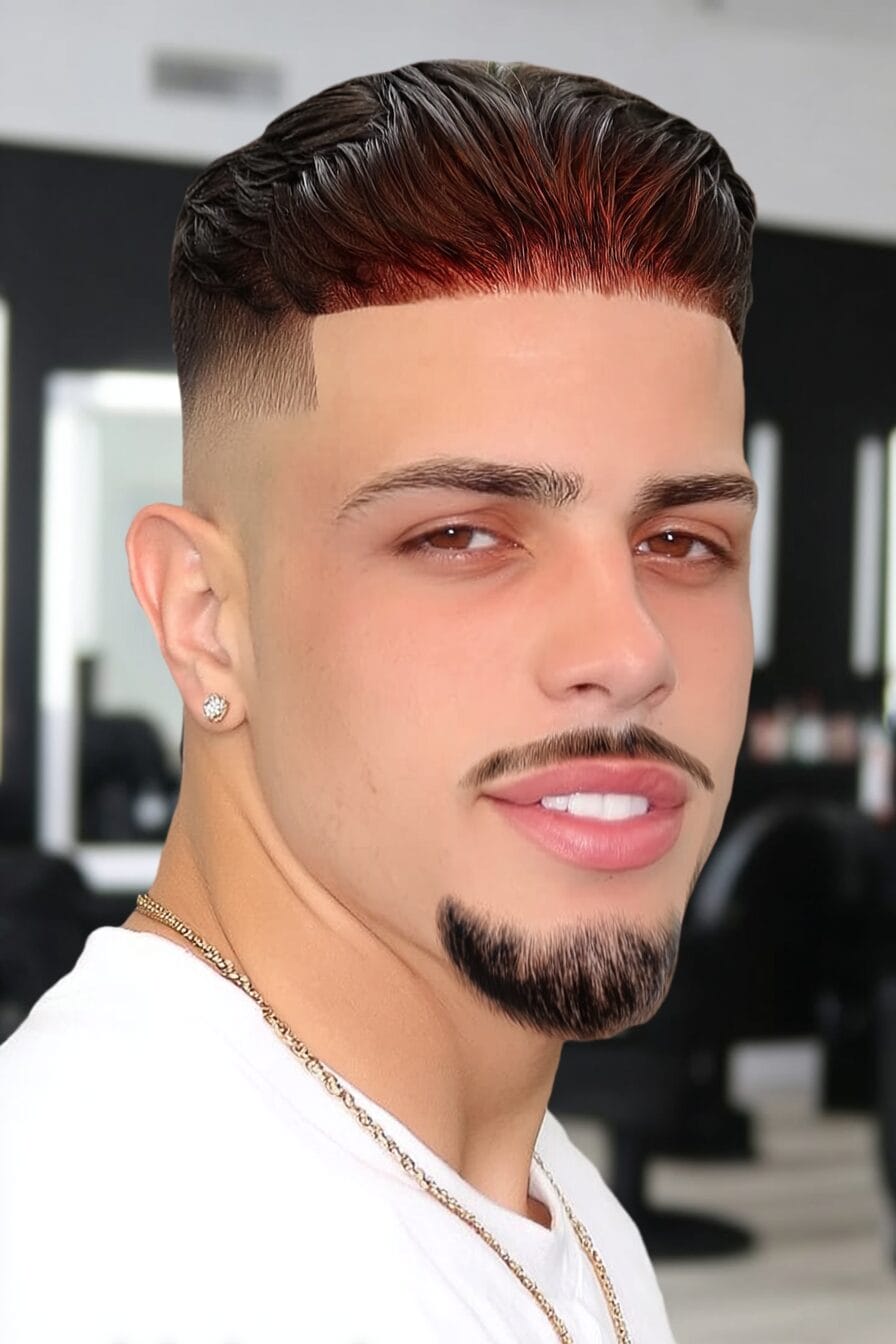
The thick-and-wide French beard is the standout trend version this year — barbers everywhere are cutting more of these in 2026 as men chase stronger jawline emphasis without a full beard’s coverage. It’s built for long, narrow, or oval faces that can absorb the width; round faces should stay away. Keep the body at 10–12mm so the width has substance, and keep the bottom edge under the jaw clean — a wide beard with a scruffy neckline tips from bold into unkempt fast.
French Beard With Fade
Instead of a hard outline, the edges of the circle fade: full length at the center, graduating through 6mm, 3mm, and 1mm bands until the hair melts into bare skin. It’s the beard equivalent of a skin fade haircut.

This crossover took off as the beard fade became one of the most-requested finishes in barbering. It photographs beautifully and pairs especially well with faded or cropped haircuts — a buzz cut with a faded French beard is one of the cleanest combinations I cut. Be honest with yourself about upkeep though: a fade grows out in a week, so this means seeing your barber (or being very handy with your own guards) far more often than the classic version demands.
Rounded French Beard
Every line in this version curves — the chin sweeps in a soft arc, the outer edges bow gently, and there isn’t a hard corner anywhere. It’s the friendliest, most approachable reading of the French beard.

Rounded shaping is what I reach for on square and angular faces, where the soft curve takes the aggression out of a heavy jaw and sharp chin. It’s also the most natural-looking outline, since hair wants to grow in curves anyway — meaning easier maintenance and more forgiving regrowth. When trimming at home, follow the natural curve of your chin with the trimmer rather than imposing straight lines, and check symmetry from below your chin in the mirror, where uneven curves show first.
Angular French Beard Style
The geometric counterpoint: squared corners at the chin, vertical sides, and edges that run in straight lines. The circle becomes closer to a rounded rectangle, and the whole face picks up structure from it.

This version exists to build a jawline that nature didn’t supply. On soft, round, or slightly fuller faces, those straight verticals and squared chin corners create shadow and definition exactly where bone structure would sit. It demands precise upkeep — straight lines show errors that curves absorb — so budget an edge session every three days with a bare trimmer blade. Ask your barber to “square the chin and keep the sides vertical.” Skip it if your jaw is already sharp; you’d be doubling up.
French Beard For Square Face
A square face — wide jaw, strong chin, roughly equal width and length — needs a French beard that softens rather than sharpens. The formula: rounded edges, a slightly longer chin section, and width kept modest.

The extra 5–10mm of chin length is doing the real work here, stretching the face just enough to break up the squareness, while the curved outline avoids stacking more angles onto an angular bone structure. Keep the connectors and mustache at 6–8mm so the visual weight stays low at the chin. This is one of the easiest face shapes to flatter with a French beard — nearly every version works — but the rounded-and-slightly-long formula works best of all.
Professional French Beard
The corporate spec: 6–8mm all round, edges defined but not theatrically sharp, neckline immaculate, not a stray hair anywhere. Conservative enough for any boardroom, present enough to still count as a beard.

What makes a beard read “professional” isn’t the style — it’s the evidence of maintenance. A tidy French beard signals discipline in a way a scruffy full beard never can, which is why this style has quietly become standard in banking, law, and client-facing work. My spec for it: length pass weekly, edge pass every three days, neckline shaved with a razor, and beard oil so the hair sits flat rather than bristling. Total time cost: maybe fifteen minutes a week.
Heavy Stubble French Style
The whole circle held at 4–5mm — the “ten-day shadow” length — with the outline clearly defined but the texture unmistakably stubble. It’s the French beard at its most effortless-looking.

Heavy stubble consistently polls as one of the most attractive facial hair lengths, and shaping it into a French outline gives it intent that all-over scruff lacks. It’s also merciful to patchy growers: at 4mm, minor density gaps read as texture rather than holes. The catch is that stubble passes through this window fast — hold the length with a guard pass every two to three days or it quietly becomes a short beard. Softer edges suit this length better than razor lines.
French Beard With Pencil Mustache
A thin, precisely lined mustache — just a few millimeters of hair riding above the lip — paired with a clean chin beard below. It’s a vintage Hollywood detail grafted onto a modern shape.

This is precision work: the pencil mustache is created by shaving the upper portion of your mustache growth and keeping what remains at 2–3mm, with dead-straight top and bottom edges. A steady hand and a proper blade matter more here than anywhere else on this list, and the edges need re-lining every other day. It suits confident dressers and slim faces; on a wide face the thin line can look lost. Not for everyone — but nobody wears it accidentally, and that’s the appeal.
Sculpted French Beard
Every edge carved to a hard, polished line — outline, neckline, mustache border, all of it finished as if drawn on. This is the version you see on grooming campaign posters, and it’s a genuine showcase of barbering craft.

Realistic expectations: this look is created with a razor’s edge and holds for about three days before regrowth blurs it. Clients who wear it well either sit in my chair weekly or have learned to re-line it themselves with a bare blade and a very steady hand. A little beard balm brushed through the body keeps the hair sitting uniformly so the sculpted outline stays the star. If you like sharp but can’t commit to the schedule, the “sharp lines” version further down is the saner middle ground.
Natural French Beard Look
The circle is maintained — length controlled, neckline in check — but the outlines are left where the hair naturally grows, with no shaved-in edges at all. It’s a French beard that looks born, not built.
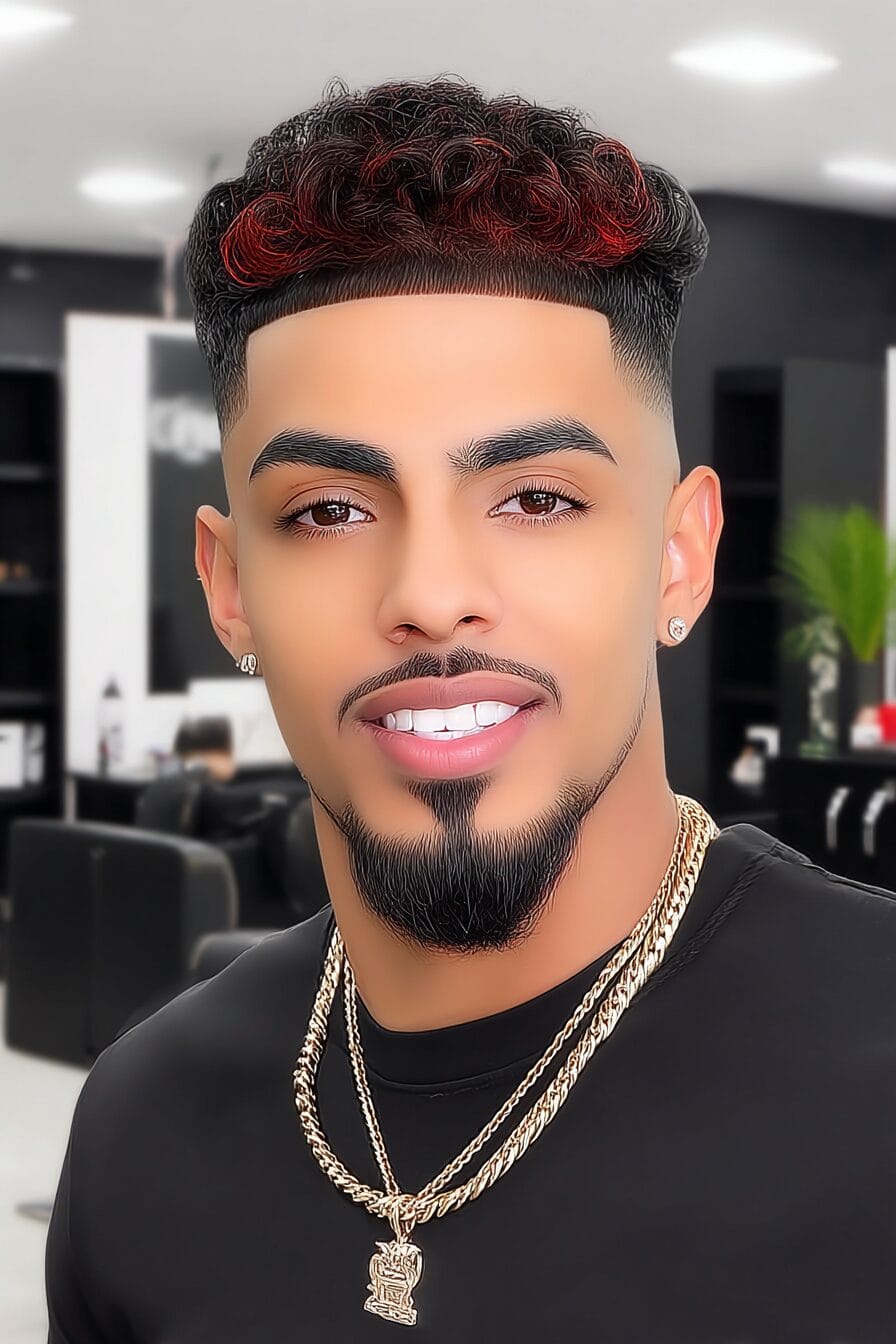
This is the direction grooming has been drifting in 2026: away from laser-cut edges and toward shapes that look effortless while secretly still being managed. The maintenance is honest, not absent — you’re still trimming the body to 8–10mm weekly and clearing the neck, you’re just not policing the perimeter. It pairs naturally with relaxed, low-maintenance haircuts, and it suits men whose growth pattern is already fairly even at the edges. Patchy-edged growers should stick to defined outlines, which hide irregularity better.
French Beard With Sharp Lines
The everyday version of sculpted: crisp, razor-finished edges on the cheek line and neckline, but without the full carved-poster treatment. Sharp where it counts, sane to maintain.

The cheek line is the money line — one clean stroke from the mustache corner down to the chin on each side, and the whole beard instantly looks barbered. I finish these with a straight razor because nothing else leaves that glassy edge; if you’re doing it yourself, a well-maintained blade is non-negotiable, and my guide on keeping a straight razor sharp covers the upkeep. Re-line every three to four days. Suits basically everyone except very short stubble lengths, where hard edges look drawn-on.
Salt and Pepper French Beard
Gray arrives in the beard before it arrives anywhere else, and the French beard is the single best frame for it — a compact shape where the mix of dark and silver reads as texture and intent rather than age.
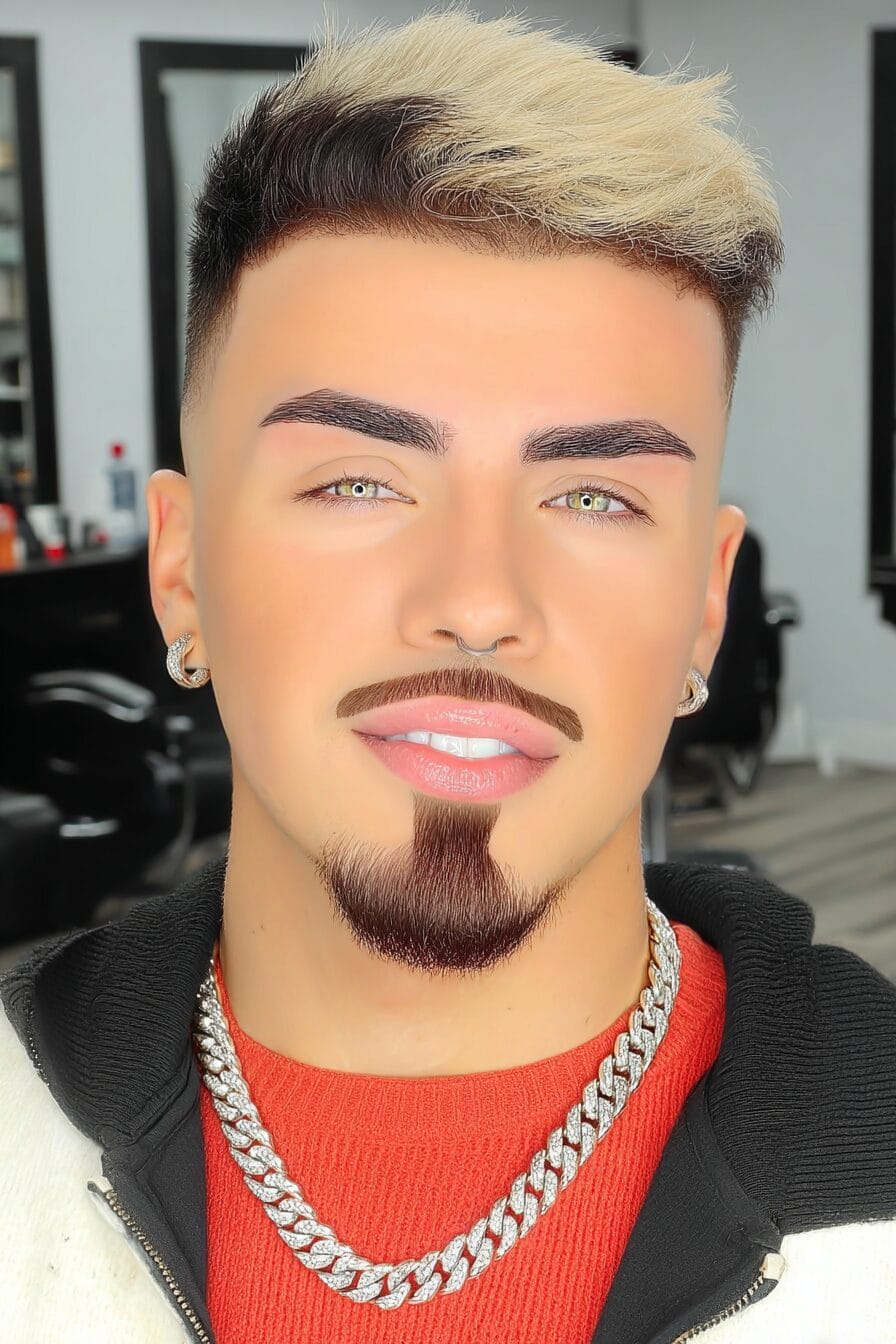
Gray hair is coarser and grows less cooperatively, so keep this version slightly shorter — 8–10mm — where the wiry texture stays disciplined, and use beard oil daily because gray hair runs dry. Whatever you do, don’t dye it; a dyed beard against aging skin fools no one, while an owned salt-and-pepper beard reads as confidence. It pairs brilliantly with salt and pepper hair up top. Some men wait their whole lives for hair this distinguished — if you’ve got it, frame it.
Thick French Beard Style
Density over length: the circle stays compact at 10–12mm but is grown in so full that it reads as a solid block of hair, no skin visible. The impact comes from richness, not size.

You can’t trim your way to thickness — this one is decided by genetics and patience. What you can do is maximize what you have: brush daily with a boar-bristle brush to train every hair downward into the shape, keep it oiled so it lies flat and dense rather than frizzing thin, and trim only for evenness, since uniform length reads thicker than mixed lengths. Give it a full eight weeks of growth before judging whether you can carry it. Suits every face shape that suits the classic.
French Beard For Round Face
The round-face formula is the narrow circle plus a longer chin: width held inside the mouth corners, chin section carrying an extra centimeter or more of length. Together they stretch the face vertically and slim it horizontally.

This is where the French beard genuinely outperforms nearly every other beard style — full beards add width to round faces, but this shape only adds length, exactly where a round face needs it. Keep the cheeks shaved absolutely clean, since bare cheeks are half the slimming effect. It works even better when the hair up top cooperates: height-building cuts like a Caesar for round faces or the other round-face haircuts I’ve covered double the lengthening effect from above.
Modern French Beard
The contemporary reading: a classic circle updated with current detailing — softly faded outer edges, a slightly heavier mustache, and small deliberate asymmetries in the outline instead of rigid geometric perfection.

This is what younger professionals actually ask me for in 2026 — the words are usually “like a French beard, but not so drawn-on.” The formula: body at 8–10mm, mustache a touch fuller than the chin, edges taken out with a 2mm guard rather than shaved to a wall, and the whole thing finished matte with a light balm, never gloss. It keeps the structure of the classic while dodging the stiff, dated look that over-defined beards have picked up. If the classic feels too formal for how you dress, this is your version.
Textured French Beard
Instead of one flat, uniform surface, the hair is left with slight length variation through the body — a controlled few millimeters of difference that gives the beard visible movement and grain.

Texture is the honest answer to wavy or unruly beard hair: rather than fighting your growth into a flat panel, you let the natural bend show and simply control its boundaries. Trim with scissor-over-comb instead of a guard if you can — scissors preserve the varied lengths that clippers flatten. A tiny amount of balm worked through with fingertips, not a brush, keeps the separation visible. This suits thick, coarse, or curly-bearded men best; fine straight hair doesn’t hold texture and ends up just looking uneven.
French Beard With Soft Edges
No hard shave line anywhere — the perimeter of the circle is taken down with a 1–2mm guard so the beard eases into bare skin over a few millimeters instead of stopping dead. Subtle at a distance, noticeably gentler up close.

Beyond being on-trend, soft edging is my standard recommendation for men prone to razor bumps and ingrown hairs — common with coarse or curly growth — because the perimeter is clipper-work only, and the razor never touches the skin. You keep nearly all the definition of a lined beard with a fraction of the irritation. Run the 1mm guard around the outline every three days, angling the trimmer away from the beard so the transition stays gradual. The neckline still needs clearing, but a trimmer handles that too.
Mature French Beard Style
For men in their fifties and beyond: the circle worn slightly fuller — 10–12mm — with soft edges and the gray left proudly in place. As the jawline naturally softens with age, this shape quietly rebuilds structure at the chin.

Older beard hair is drier, coarser, and slower-growing, so the routine shifts: oil becomes daily and non-negotiable, a weekly trim keeps wiry strays in line, and washing drops to two or three times a week so you’re not stripping what natural oil remains. I fit this beard to a lot of men who’ve never worn one before retirement age, and the reaction is almost always the same — they wish they’d started twenty years earlier. It flatters every face shape and pairs beautifully with silver hair.

Choosing a French Beard for Your Face Shape
Every version above is really just the same circle re-proportioned, which means the choosing logic is simple. Here’s the cheat sheet I run through with clients in the chair:
- Round face: narrow width, longer chin — see the round-face version above. Avoid the wide and extended styles.
- Square face: rounded edges and a slightly longer chin to soften the jaw. Avoid the angular version.
- Oval face: the lottery winner — every version works. Start with the classic and experiment from there.
- Long or oblong face: the wide or extended versions add balancing width. Avoid extra chin length.
- Diamond face: the full or thick versions fill out a narrow chin. The Balbo-adjacent wide shapes also work.
- Soft or fuller face: the angular version builds definition where you want it.
Not sure which shape you’re actually working with? Most men guess wrong. Run your photo through my free face shape detector first, then let the beard style quiz match a style to the result — the two tools together take about two minutes and settle the question properly.
FAQs: French Beard Styles
How long does it take to grow a French beard?
Four to six weeks for most men. You need roughly 10mm of length everywhere in the circle before the first proper shape-up, and the mustache and connectors usually lag behind the chin, so the chin being ready doesn’t mean the beard is. Resist trimming anything except the neckline before week four — early trimming of a short beard is the most common way men accidentally erase their connectors.
What face shape suits a French beard best?
Oval faces carry every version effortlessly, but the style’s real strength is that it adjusts to fit anyone: narrow-and-long versions slim round faces, rounded versions soften square jaws, wide versions balance long faces. Because the cheeks are shaved clean, it never adds unwanted width — which is the usual way beards go wrong on wider faces. There is no face shape I’d flatly refuse to put a French beard on.
How often should I trim a French beard?
Edges every three to five days, a full length pass weekly. The style’s whole effect lives in its clean perimeter, so edge work is the non-negotiable half — a fuzzy outline undoes the look faster than extra length does. A monthly professional visit is worth it early on while you learn the lines; after that, most men maintain it entirely at home in about fifteen minutes a week.
Can I grow a French beard with patchy cheeks?
Yes — it’s the single best beard style for patchy cheeks, because the patchy area gets shaved anyway. All the style requires is decent growth in the mustache, connectors, and chin. If your connectors are also thin, wear the disconnected version and keep the gap deliberately clean. Understanding your own beard growth pattern first will tell you which version your face can actually support.
What’s the difference between a French beard and a Van Dyke?
Connection. The French beard keeps the mustache and chin beard joined in a closed circle; the Van Dyke separates them with shaved skin and usually points the chin section rather than rounding it. In the chair the decision often makes itself: strong connector growth suggests the French beard, weak connectors suggest the Van Dyke, which turns that gap into a feature.
Is a French beard suitable for the workplace?
It’s arguably the most office-safe beard there is. A maintained French beard signals discipline rather than scruff, which is why it’s become a quiet standard in client-facing professions. Keep it at 6–8mm, keep the neckline shaved, and re-edge every three days — the professional version above is the exact spec. In genuinely conservative environments it outperforms stubble, which some dress codes still read as unshaven.
Was this article helpful?
Find Your Perfect Beard Style
You’ve seen the options. Now find the one that actually suits YOUR face shape and growth pattern.
Take the Quiz →
Khamis Maiouf is a professional barber who graduated from Hinckley College in England with a Level 3 qualification in hairdressing. With over 20 years of experience, he is an award-winning barber who has mentored numerous students and styled thousands of clients. A recognised expert featured on StyleCraze (20M+ readers).
Credentials: Level 3 Hairdressing (Hinckley College, UK) • 20+ Years Professional Experience • Featured Expert on StyleCraze • Founder of Book of Barbering