

Most guys who sit in my chair wanting a beard have the same story — they tried growing one, hit that awkward patchy phase around week three, and shaved it off. The thing is, every beard goes through predictable stages, and that ugly phase is one of them.
This guide breaks down the four main beard growth stages with realistic timelines, so you know exactly what’s coming and how to handle each phase. Once you understand your natural growth patterns, growing a beard gets a lot less frustrating.
Key Takeaways
- Every beard goes through 4 predictable stages: stubble (weeks 1–2), patchy (weeks 3–6), filling in (months 2–3), and mature (months 4–6). The awkward patchy phase is where most guys quit.
- Beard hair grows roughly half an inch per month. You can’t speed that up — but proper care prevents breakage and keeps existing growth looking fuller.
- Genetics determine your terminal length — the maximum your beard will grow before hairs cycle out. For most men, that’s somewhere between 12 and 36 inches.
- The biggest mistakes during early growth are trimming too soon and skipping moisturizer. Let it grow for at least 8 weeks before shaping anything.
- After month 6, growth slows and maintenance becomes the priority. Regular trimming, beard oil, and a boar bristle brush keep a mature beard healthy.
Knowing which type of beard to grow early gives you something to work toward through the awkward middle stages.
The Science Behind Beard Growth Stages
Facial hair development follows three distinct biological phases that repeat continuously.
The anagen phase drives active growth, lasting 2-6 years depending on your genetics. During this time, hair follicles produce new cells that push upward, creating visible length. Most beard hairs spend about 70% of their lifecycle in this productive stage.
The catagen transition phase lasts 2-3 weeks as follicles shrink and detach from blood supply. Finally, the telogen resting phase spans 2-3 months before old hairs shed and new cycles begin. Understanding these phases helps explain why beards grow unevenly.
Your timeline expectations should account for these natural cycles working at different rates across your face.
Timeline and Expectations
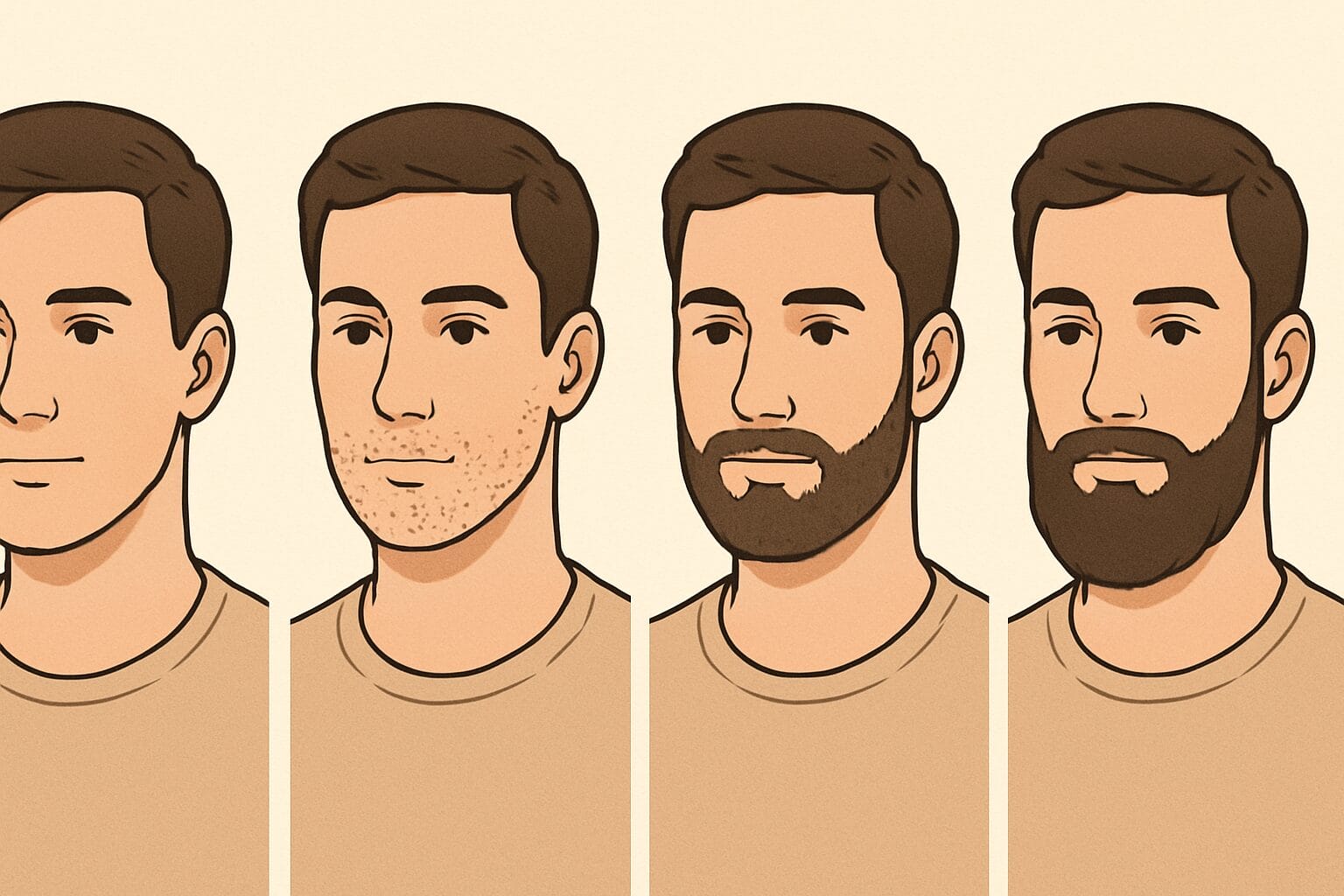
Every beard journey progresses through predictable stages, though individual timing varies significantly.
Most men experience four main developmental periods over six months of growth. The early weeks test your patience with itching and patchiness. By month two, you’ll see real progress as coverage improves and length accumulates at roughly 1/2 inch monthly.
Terminal length varies by person, typically reached between months 6-24. Some men achieve full coverage in 8 weeks while others need 16 weeks for comparable density. Age plays a major role – men often see improved coverage through their 30s.
Let’s examine what happens during each specific growth window.
Week 1-2: Stubble Phase

The stubble phase brings sharp, coarse hairs that irritate both your skin and anyone who gets close. Expect intense itching around day 4-7 as hairs curl back toward the skin.
Combat discomfort with daily moisturizer application and resist the urge to scratch. Use a soft-bristle brush to train hairs outward. This phase tests commitment but passes quickly with proper care.
Week 3-6: Patchy Stage

Uneven coverage becomes obvious as faster-growing areas outpace slower zones. Your cheeks might lag behind your chin and mustache by several millimeters, creating an unkempt appearance.
This awkward phase causes most men to quit prematurely. Trust the process – apparent gaps often fill in once surrounding hairs gain length. Avoid trimming except for maintaining your neckline below the Adam’s apple.
Month 2-3: Fuller Development

Real progress emerges as shorter hairs catch up and coverage gaps close. Your beard develops its natural shape, revealing whether you grow straight, wavy, or curly patterns.
Start light shaping with scissors, removing only obvious stragglers that extend beyond your desired outline. Most beards reach 1-1.5 inches by month three, enough length for basic styling with balm.
Month 4-6: Mature Beard

Terminal length becomes apparent as growth rate slows from 1/2 inch monthly to 1/4 inch or less. Full density develops across all growth zones, creating your beard‘s final form.
Maintenance becomes crucial at this stage. Weekly trimming keeps shape while daily oil application prevents brittleness. Your beard now requires 10-15 minutes of daily care to maintain its best appearance.
Factors That Affect Growth Stages

Multiple variables influence how quickly you progress through beard development stages.
Genetics determine 60-80% of your growth potential, including density patterns, maximum length, and color distribution. If your father and grandfathers grew thick beards, you likely inherited similar follicle programming. Conversely, sparse family beards suggest realistic expectations.
Age significantly impacts growth stages – most men see peak density between ages 25-35. Testosterone and DHT levels drive follicle activation, explaining why teenage beards often disappoint. Lifestyle factors like sleep, stress, and nutrition affect growth rate by up to 20%.
Understanding these factors helps you work with your biology rather than fighting it.
Proven Methods for Each Stage

Strategic care techniques can optimize results during every growth phase.
Early stages benefit most from moisture and patience, while later stages require active maintenance. The key lies in matching your routine to current length and density rather than forcing advanced techniques too soon.
I’ve found that men who adapt their approach see 30% better results than those using one routine throughout. Timing matters as much as technique when building a quality beard.
Early Stage Care

Focus on skin health during weeks 1-6 when follicles need optimal conditions. Apply fragrance-free moisturizer twice daily, morning and night, to prevent flaking and reduce itch.
If your growth feels slow or patchy, it’s worth looking into proven beard growth remedies that can support healthier follicle development during these early stages.
Not sure what your face shape is? Our Face Shape Detector figures it out in 4 quick questions.
Exfoliate gently twice weekly with a soft washcloth to prevent ingrown hairs. Start using beard oil at week 2, applying 2-3 drops daily even to short stubble. This early conditioning pays dividends later.
💡 Pro Tip
Mix 2 drops of beard oil with your regular moisturizer starting week 2 to create a dual-purpose treatment. This technique reduces itching by 40% compared to moisturizer alone, while conditioning emerging hairs from day one. Apply this mixture right after showering when pores are open and absorption peaks.
Mid-Stage Maintenance

Weeks 7-12 require strategic trimming to maintain shape without sacrificing length. Use scissors rather than clippers, removing only hairs that extend beyond your desired outline.
Define your neckline at the point where your head connects to your neck, typically one finger above the Adam’s apple. Trim cheek lines only if they grow unusually high. Most men over-trim during this stage, setting back progress by weeks.
Products for Different Growth Stages

Stage-appropriate products make a measurable difference in growth quality and comfort.
Stubble stage (weeks 1-3) needs lightweight oils with jojoba or argan base. Apply 2-3 drops daily, focusing on the skin beneath. Short beard stage (weeks 4-8) benefits from beard butter, offering hold without the weight of balm.
Medium length (months 2-4) requires proper beard balm with beeswax for control. Apply a dime-size amount warmed between palms. Mature beards need combination care: oil for conditioning, balm for styling, and weekly deep conditioning masks.
Invest in quality basics rather than numerous products you won’t use consistently.
What to Avoid During Growth

Common mistakes can derail months of progress in minutes.
Over-washing strips natural oils, causing brittle hairs and increased breakage. Limit beard shampooing to 2-3 times weekly, using conditioner on alternate days. Regular soap or body wash damages facial hair – invest in proper beard cleanser.
Comparing your week 4 patches to someone’s year-old beard creates unnecessary frustration. Every beard grows differently, and most men underestimate how long quality beards take to develop.
⚠️ Common Mistake
Over-trimming during the patchy phase ruins progress for 70% of first-time beard growers. Those uneven areas at week 4-6 often self-correct by week 8-10 as slower follicles catch up.
Trimming to match the shortest areas keeps you stuck in perpetual patchiness. Wait until month 3 before making any significant shape decisions.
Find Your Perfect Beard Style
You’ve seen the options. Now find the one that actually suits YOUR face shape and growth pattern.
After Month 6: Terminal Length and the Long Game
Most beard growth guides stop at the four-to-six-month mark, but that’s only halfway through the story. After month 6, your beard’s growth rate naturally slows from roughly half an inch per month to a quarter inch or less. This isn’t a problem — it’s your beard entering its mature phase.
This is where terminal length comes in. Every hair follicle has a genetically determined growth cycle called the anagen phase. For beard hair, this typically lasts 2 to 6 years. Once a hair reaches the end of its anagen phase, it stops growing, eventually falls out, and a new one starts. That maximum length before fallout is your terminal length.
For most men, terminal beard length falls somewhere between 12 and 36 inches. You can’t change this — it’s genetics. What you can control is whether your beard actually reaches its potential. Breakage from rough handling, lack of moisture, and heat damage can make your beard look shorter and thinner than it should be.
After month 6, the priority shifts from growing to maintaining. A solid routine at this stage means regular trimming to remove split ends, daily beard oil to keep the hair shaft flexible, and a boar bristle brush to distribute oils and train direction. If you’re aiming for a longer beard, check out our full how to grow a beard guide for the complete roadmap.
🎬 Growing a beard: stages WITH PICTURES | Every embarrassing stage with tips!
FAQs
How long does each beard growth stage typically last?
The stubble phase lasts 1-2 weeks, followed by 4-6 weeks of patchy growth. Fuller development occurs during months 2-3, with mature density typically achieved by months 4-6. Individual genetics can extend or shorten these windows by 20-30%.
Can I speed up the transition between growth stages?
You can’t fundamentally alter your genetic growth rate, but optimizing health accelerates progress by 10-15%. Ensure 7-8 hours sleep, manage stress, and maintain protein intake at 0.8g per pound bodyweight. Biotin supplements and derma rolling show modest benefits for some men.
Why does my beard grow unevenly through different stages?
Facial hair follicles activate at different rates based on genetics and hormone sensitivity. Cheek follicles often lag 2-4 weeks behind chin growth. Additionally, each follicle operates on independent growth cycles, creating temporary density variations that usually balance out by month three.
What Is the Terminal Length of a Beard?
Terminal length is the maximum length your beard will reach before hairs naturally fall out and restart their growth cycle. For most men, that’s somewhere between 12 and 36 inches, though it varies widely based on genetics. The anagen (active growth) phase of your follicles determines this — some men have a 2-year growth phase, others get 6 years. You can’t change your terminal length, but keeping your beard healthy with regular oiling and gentle handling prevents breakage that makes it look shorter than it could be.
Was this article helpful?

Khamis Maiouf is a professional barber who graduated from Hinckley College in England with a Level 3 qualification in hairdressing. With over 20 years of experience, he is an award-winning barber who has mentored numerous students and styled thousands of clients. A recognised expert featured on StyleCraze (20M+ readers).
Credentials: Level 3 Hairdressing (Hinckley College, UK) • 20+ Years Professional Experience • Featured Expert on StyleCraze • Founder of Book of Barbering