

Curly hair hides the one thing every good haircut needs: a clean edge. The hair rolls over the ears and the neckline, and after ten days it looks like no shape at all. A low fade fixes exactly that — it puts a sharp, tight frame around the bottom inch of the cut while leaving every bit of curl on top untouched. That’s why, of all the fades I cut, the low version is the one I recommend most for curls.
It’s also where the trend has landed. The high-contrast, shaved-sides look has cooled off, and what men are asking for now is a lower, softer blend with a matte finish — the fade sits quietly and the curls do the talking. In this guide I’ll walk you through every low fade style that works with curly hair, which curl type each one suits, the exact guard numbers involved, and what to say in the chair so you walk out with the right one.
Cutting at home? See my barber’s guide to a barber’s pick of fade clippers.
Key Takeaways
- A low fade starts about half an inch above the ear — it removes the least hair of any fade, so your curls keep maximum volume
- The current trend is lower, softer blends with a matte finish — the fade frames the curls instead of competing with them
- Always get the fade cut on dry hair — curls spring up 20-40% when they dry (tight coils even more), and a wet cut lies about where the blend sits
- Curly hair needs rocking clipper motions and varied angles, not the straight flicking used on straight hair
- Touch up the fade every 2-3 weeks, and style with curl cream, not gel — keep all product off the faded sides
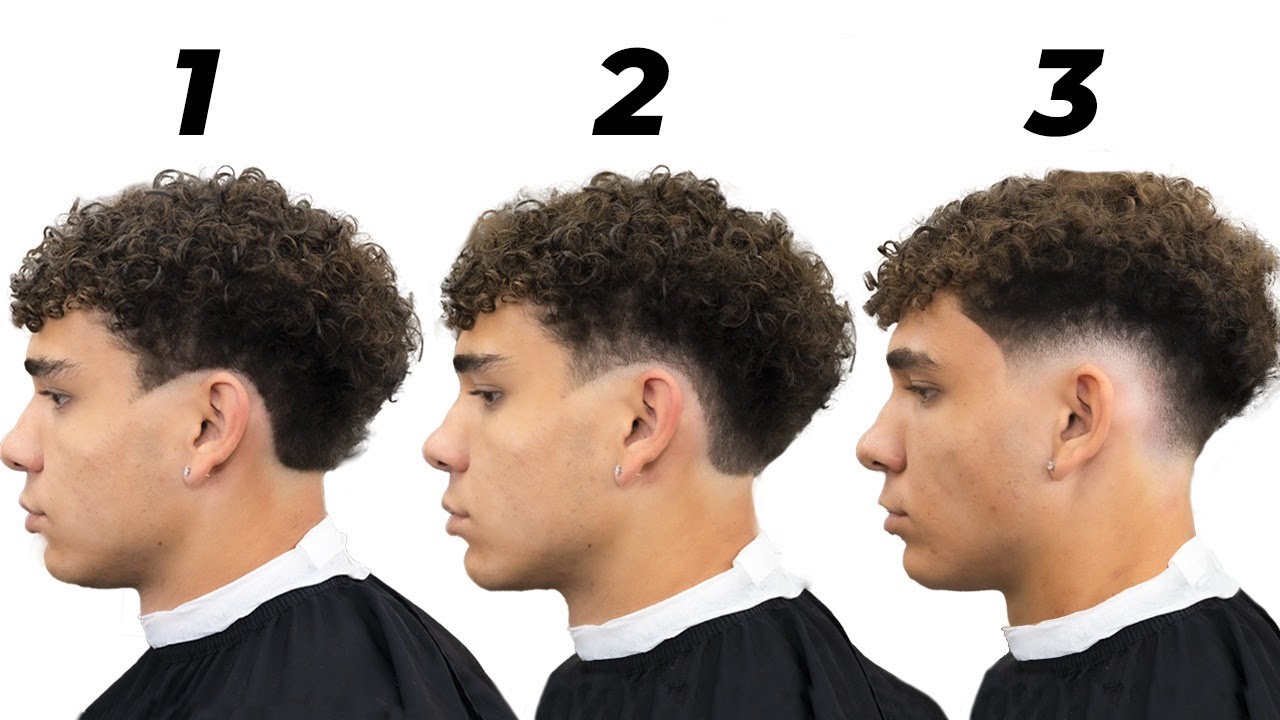
Looking for boy-specific guidance? The curly hair styles for boys guide breaks down what works at each age.
Keep the Curls on Top Sharp
A low fade keeps the sides clean, but the curly top is where this style lives or dies. These keep those curls defined, soft and frizz-free between cuts.
STMNT Men’s Curl Cream
Defines curls without the crunch — soft, touchable texture and frizz control, from a brand built for men’s hair.
Check it on Amazon →Moroccanoil Curl Defining Cream
The salon standard. A little goes a long way: bouncy, defined curls with real shine and a hold that lasts all day.
Check it on Amazon →Conair Universal Diffuser
Fits almost any dryer. Dries curls evenly instead of blowing them into frizz — the cheap tool that makes curls actually hold.
Check it on Amazon →As an Amazon Associate, I earn from qualifying purchases — at no extra cost to you. Current price and availability are shown on Amazon.
Low Fade vs Mid Fade vs High Fade for Curly Hair
This is the first thing I settle with every curly-haired client: where does the fade start? On straight hair the difference between low, mid and high is a style preference. On curly hair it decides how much of your actual curl survives the haircut, so it’s worth getting right before the clippers come out.
A low fade starts about half an inch above the ear and stays below the temple. It removes the least hair, which means the curl keeps its weight and its spring — and it’s the easiest fade to grow out if you change your mind. This is my default recommendation for curls, and it’s the direction most of my clients have moved over the last year or two: lower starting point, tighter blend zone, nothing dramatic. It reads professional in any office and still looks sharp in photos.
A mid fade puts the shortest point at the temple. It opens up the sides of the face more, and it suits 3A-3B ringlets particularly well because the curls sit on top like a crown with a visible frame under them. The trade-off is you lose some of the rounded silhouette that makes curly hair look full.
A high fade climbs above the temple and leaves curl only on top. It’s the boldest contrast and it photographs well on tight coils, but it needs a touch-up every 10-14 days to stay clean, and grown-out high fades on curly hair look messier than any other combination I cut.
My honest advice: if you’re new to fades, start low. You can always move the line up next visit — but if a taper or fade goes too high on day one, the only fix is waiting.
Classic Low Fade Styles For Curly Hair
These are the low fade variations I cut week in, week out. Every one of them keeps the fade below the temple — the difference is in how hard the bottom edge contrasts with the curl, and which curl pattern each one flatters.
Read the descriptions, then pick by your texture, not by the photo alone. The same fade sits completely differently on loose waves than on tight coils.
Traditional Low Skin Fade With Natural Curls
The low skin fade takes the bottom edge all the way down to bare skin, then climbs quickly through a zero, a #1 and a #2 before the curl takes over. Because the fade band is so compact, the jump from skin to full curl happens in about two inches — that contrast is what makes the curls on top look thicker than they really are.
It suits medium to tight patterns (3B through 4C) best, because dense curl against shaved skin gives the cleanest line. On loose waves the same fade can look like the sides simply ran out of hair, so I steer wavy clients toward the taper or shadow versions below.
How to ask for it: “low skin fade, keep the blend tight, don’t take it above the ear by more than a finger’s width.” A good barber will finish the skin section with a foil shaver, not just the bare clipper blade — you should feel smooth skin, not stubble, when you run a finger above your ear.

Subtle Low Taper Fade For Defined Ringlets
The low taper fade is the gentlest option on this page and, right now, the single most requested cut for curly hair — it only shortens two zones, the sideburn and the neckline, and leaves everything between them alone. Nothing goes below a #1, most of the side sits at a #2 or #3, and your ringlets keep their full fall.
This is the one I recommend for defined 3A-3B ringlets, because ringlets need a little length to actually form a ring. Cut the sides too short and the curl can’t complete its loop — you get frizz where you used to have spirals. The taper protects that, and it’s also the kindest option for textured hair that’s being grown out.
How to ask for it: “low taper, #2 minimum on the sides, just clean the sideburn and the neckline into the skin.” Maintenance is forgiving too — a grown-out taper still looks intentional at week four, which no skin fade can claim.

Clean Low Fade With Loose Curl Pattern
Loose curls and strong waves (2B to 3A) need a different treatment, because there’s less visual density on top to balance a hard fade. Here I keep the bottom at a #1 rather than skin, start the fade half an inch above the ear, and stretch the blend a touch longer so the wave appears to melt into the sides instead of stopping at a line.
The top matters as much as the fade with this pattern. I cut it with scissors, point-cutting into the ends so the waves stack with movement rather than sitting flat — clippers on a loose-curl top flatten the very texture you’re trying to show off.
How to ask for it: “low fade, #1 at the bottom, scissor the top and keep the length — I want the wave to connect to the fade, no hard line.” If your hair is more wave than curl, this is your cut.

Vintage-Inspired Low Fade With Coiled Texture
This one borrows the 1950s barbershop shape — conservative low fade, defined side area, weight kept toward the front — and lets modern coiled texture replace the pomade shine that era relied on. Your coils produce the volume those cuts used to fake with product, which is why the combination works so well today.
The detail that sells it is a hard part: a thin shaved line where the parting would naturally sit. On coiled texture a hard part does real work, because coils don’t show a natural parting the way straight hair does. Keep it thin — a pencil line, not a stripe.
Finish matters here: ask for a matte product, never a gloss. A shiny finish on this cut tips it from vintage-inspired into costume.

Low Drop Fade With Curly Fringe
The drop fade curves down behind the ear instead of running in a straight band around the head. That arc follows the natural shape of the skull, so the fade looks built for your head rather than stamped onto it — and it leaves a little more weight at the back, which balances a curly fringe worn forward.
Pairing it with a curly fringe is the move for round and soft face shapes: the fringe adds vertical height at the front while the dropping arc pulls the profile longer at the back. If the broccoli-cut years taught men one thing, it’s that curls worn forward flatter almost everyone — this is the grown-up version of that idea, with a cleaner frame.
How to ask for it: “low drop fade, follow it down behind the ear, and leave the fringe heavy — I want to wear it forward.”
Low Burst Fade For Tight Curls
The burst fade radiates out from a point around the ear in a semicircle and deliberately leaves the neckline longer. On tight curls and afro textures (4A-4C) it’s a brilliant shape, because the curl seems to burst outward from the faded arc — the cut builds energy into hair that already has it.
Technically it’s one of the harder fades to keep even, since the blend changes direction constantly around the curve of the ear. This is a cut where barber choice matters more than usual: look for someone whose photos show burst fades on textured hair specifically, not just straight-hair versions.
How to ask for it: “low burst fade around the ear, keep the nape — don’t square the neckline off.” It pairs naturally with a sponge-twisted or picked-out top.

Shadow Low Fade For Wavy-Curly Hair
A shadow fade never touches skin — nothing shorter than a #1 anywhere on the head. The result is a soft gradient that looks like shading rather than a cut line, which is exactly where fades have been heading lately: less contrast, more blend.
For wavy-curly hair between 2C and 3A this is the sweet spot. The texture on top is too soft to fight a skin fade, but a shadow fade sits underneath it like a shadow should — you notice the shape, not the fade. It’s also the most office-proof option here, and the slowest to look grown out.
How to ask for it: “shadow fade, low, nothing below a #1 — I don’t want to see skin.” If your hair is fine or your skin shows pink after a close cut, this version will also be the most comfortable to wear.
Shoulder-Length Curls With Low Undercut Fade
Once curls pass chin length, weight becomes the enemy — the sides puff outward, the silhouette turns triangular, and most men give up and tie it back. The low undercut fade solves that by clearing the bulk from below the parietal ridge (the widest point of your head) while the length on top stays completely intact.
Take the weight off the sides and the remaining curls hang better immediately: more bounce, faster drying, no triangle. It’s the best-kept secret for men who want long hair without the full maintenance load of it.
How to ask for it: “low undercut fade, take the sides to a #2 under the ridge, don’t touch the length on top.” One warning from experience — commit to it, because the regrowth stage when the undercut catches up to the top takes months.

Texture-Specific Low Fade Cuts
Two clients can ask for “a low fade with curls” and need two completely different haircuts. Before I pick up the clippers I’m reading three things: how tight the curl coils, how dense it grows, and how much it shrinks when it dries. Those three answers change the guards, the technique and even the order I cut in.
Here’s how I adjust the same low fade across the curl chart:
- 2A-2C (waves): longest blend zone, #1 minimum at the bottom, scissors on top. Waves show every clipper mistake, so the fade must be stretched and soft.
- 3A-3B (ringlets): protect the length on top so the rings can form — taper or shadow fade, and I cut the top damp, then check it dry.
- 3C-4A (tight curls): skin and burst fades shine here; the density carries hard contrast. I fade dry, working against the curl direction first.
- 4B-4C (coils): shrinkage can hide up to three-quarters of the true length, so I stretch-test sections before cutting and always shape the top picked out, never flattened.
“The fade is the frame, the curl is the picture. My job is matching the frame to the picture — never trimming the picture to fit the frame.”

Professional Barber Techniques
This section is for two people: barbers learning to fade texture, and clients who want to know whether the person cutting their hair actually knows curls. Watch for these techniques from the chair — they’re the difference between a fade that grows out gracefully and one that falls apart in a week.
Everything below assumes one rule I never break on curly hair: the fade gets cut dry. Wet curls lie about their length, and a blend placed on wet hair will sit in the wrong spot by the time you reach the car park.

Clipper Guard Progressions For Low Fades
A standard low fade on curly hair runs 0 (or skin) at the bottom, then 0.5, #1, #1.5, #2 and out into the curl — with the clipper lever doing the half-steps between guards. Each guard line sits about a finger’s width above the last; on a low fade the whole progression is finished within two inches.
On tight coils I slow that progression down, sometimes working quarter-steps with the lever, because dense curl shows a banding line — a visible stripe where one guard ends — far more than straight hair does. If you’ve ever seen a fade with faint rings in it, that’s a guard progression rushed on texture.
Check your own fade in the mirror after the cut: the sides should read as one smooth gradient. If you can point at where a guard changed, the blend isn’t done.

Blending Methods For Curly Textures
The flicking wrist motion barbers learn for straight hair fails on curls, because curly hair doesn’t stand in one direction — it spirals. Flick through a spiral and you shorten one side of the curl but not the other, which reads as patchiness two days later, once the hair settles.
On texture I use a rocking motion instead: the clipper rolls through the blend zone in small arcs, first pass against the dominant curl direction to stand the hair up, second pass with it to settle the finish. Angles vary constantly — I’m following the swirl of the growth, not a straight track around the head.
It takes longer. A proper curly fade simply cannot be a ten-minute haircut, and if you’re consistently out of the chair that fast, that’s your answer on why the fade never lasts.

Scissor-Over-Comb Low Fade Technique
The top inch of a curly low fade — where the blend hands over to full curl — is the zone clippers handle worst. A clipper cuts a flat plane; curls need a graded edge. So on that transition I switch to scissor-over-comb: lift a section on the comb, cut to the comb’s angle, move up, repeat.
Scissors leave the curl’s end blunter and heavier than a clipper does, which keeps definition right where the fade meets the style. On looser patterns I’ll sometimes scissor the entire top half of the fade for a result no clipper can copy.
From the chair, this is an easy skill check: a barber who finishes your blend zone with scissors and comb understands texture. One who runs the clipper to the top edge and stops is cutting your curls like straight hair.
Freehand Low Fade For Natural Movement
Curly heads almost always have irregular growth patterns — a swirl at the crown, a cowlick above one ear, curls that grow forward on one side and back on the other. A fade line drawn by rule ignores all of that. Freehand fading means I put the guide line where your growth says it should go, not where the textbook does.
In practice that might mean the fade sits slightly higher over a cowlick so it doesn’t split, or the arc behind one ear runs a few millimetres lower than the other because your hairline does. Nobody will ever spot these adjustments — that’s the point. The fade looks like it grew there.
This is what you’re paying for with an experienced barber: not a steadier hand, but better decisions about where the lines belong on your particular head.
Not sure what your face shape is? Our Face Shape Detector figures it out in 4 quick questions.

Detailing Tools For Clean Low Fade Lines
The last ten minutes of a good fade are all detail work: a T-blade trimmer for the outline around the ears, a foil shaver for any skin sections, and — on curly hair — a very light hand. T-liners cut curly edges cleanly without snagging, which is why they’re the right tool around ears and sideburns.
The one thing I want you to watch for: the neckline and the front hairline should be cleaned, never pushed back. Straightening a curly hairline into a sharp geometric line looks crisp for exactly five days, then grows back as stubble in a place hair never naturally sat. I follow the natural hairline and just remove the strays beyond it.
Done right, detailing is what people are actually reacting to when they say a fade looks “fresh” — the gradient does the work, but the edges get the compliments.

Styling Products For Low Fade Curly Cuts
A low fade cuts your styling job in half — the sides need nothing at all. Every product you use belongs on the curly top only, and the biggest change in recent years is what that product should be: curl creams and leave-ins with a matte, natural finish have fully replaced the wet-look gels men used to rake through curls.
My rules for the top, whatever your curl type:
- Apply to damp hair, not dry — product on dry curls means frizz; damp curls lock the definition in as they dry
- Layering order: leave-in conditioner first, curl cream second, and only add a stronger holding product if your curls genuinely need it
- Keep product a finger’s width above the fade line — cream on faded sides turns to visible grease by lunchtime
- Refresh, don’t rewash: a spray of water and a scrunch each morning revives yesterday’s cream; daily shampooing dries curls out

Curl Creams For Low Fade Definition
If you buy one product for a curly low fade, buy a curl cream. It gives 2C-3B hair definition and moisture at the same time, with a soft hold that still moves — which is exactly the natural finish this cut wants. Gel-crunchy curls above a clean fade look dated now, full stop.
Application technique matters more than brand: a dime-sized amount, emulsified between both palms until it disappears, then scrunched upward into damp hair from the ends toward the roots. Rake it through with fingers first if your curls clump unevenly. Need more? Add a second small amount — one big glob overloads the crown and flattens it.
Let it air-dry, or use a diffuser on low heat if you want extra volume. Touching the curls while they dry is what breaks them into frizz — apply, shape, then leave them alone.

Sea Salt Sprays For Textured Low Fades
Sea salt spray is the right call for the loose end of the curl chart — 2A to 2C waves that want to look thicker and more piece-y over a low fade. Four or five sprays into damp hair, scrunch upward, done. It builds grit and volume that fine wavy hair can’t produce on its own.
The caution: salt is drying, and drying is the enemy of curl. I tell clients to treat salt spray as a two-or-three-days-a-week product, always over a leave-in conditioner, never on already-dry curls. Real curls (3A and tighter) usually don’t need it at all — they have texture to spare, and salt just costs them moisture.
Leave-In Conditioners For Moisturized Curls
Leave-in conditioner is the foundation everything else sits on. Curly hair runs dry by design — the spiral shape stops your scalp’s natural oils travelling down the strand — and dry curls frizz, shrink and lose their pattern. A leave-in replaces that missing moisture daily.
Work it through the curly top while the hair is still wet from the shower, concentrating on the ends, then layer your cream over it. The faded sides need none. If your curls consistently look better on day one than day three, the missing step is almost always this one, not the styler on top of it — it’s the same principle behind every good curly hair routine.
One brand-agnostic tip: on the ingredients list, water should be first and heavy waxes absent. Curls want moisture in, not coating over.

Ready to Find Your Perfect Cut?
You’ve read about the styles. Now find the one that fits YOUR face shape, hair type, and lifestyle.
Take the Quiz →FAQs
How Often Should I Get My Low Fade Touched Up With Curly Hair?
Every 2-3 weeks keeps a low fade genuinely crisp — in my book, day 14 to 18 is the sweet spot where most clients rebook. Curly regrowth is kinder than straight regrowth because the new growth curls into the fade rather than sticking out of it, so a low fade on curls stretches further than any other fade.
If you want to stretch it to four weeks, choose the taper or shadow version — both are designed to grow out softly. A skin fade past week three, though, just looks like you forgot.
Can A Low Fade Work With Very Tight Curls?
Not only can it work — tight coils (4A-4C) are where low fades look their absolute best. The density of coiled hair against a clean faded edge creates contrast that looser textures can’t match, and shrinkage actually helps here by keeping the shape compact between cuts.
The only real requirement is the barber. Coils need dry cutting, stretch-testing before the guards come out, and blending against the curl direction — ask to see fades on textured hair in their photos before you sit down.
What’s The Difference Between A Low Fade And Low Taper For Curly Hair?
A low fade blends the whole band above your ears and neckline down toward skin. A low taper only shortens two small zones — the sideburns and the neckline — and never goes shorter than about a #2 elsewhere. Fade means contrast; taper means cleanup.
On curly hair the difference shows more than on straight hair, because removing curl removes visible volume. If you want to keep the roundness of your curl silhouette, taper. If you want the sides to disappear and the top to pop, fade.
Will A Low Fade Damage My Natural Curl Pattern?
No — cutting doesn’t change curl pattern, ever. Your pattern is set at the follicle, and clippers never touch that. The faded sections grow back exactly as curly as before.
What a low fade often does is make the top curl look better: removing side bulk frees the crown curls to spring properly instead of being crowded flat. If your curls have gone limp or straighter over time, look at heat, harsh shampoo or product buildup — never the haircut.
How Much Does A Professional Low Fade Cost For Curly Hair?
Expect $25-60 in most cities, and treat the low end with some suspicion — a proper curly fade takes 45 minutes to an hour, and shops charging $15 make that time back by rushing. Barbers who specialise in textured hair often charge a premium, and in my experience the extra ten dollars buys a fade that lasts a week longer.
Budget for the year, not the visit: at a touch-up every 2-3 weeks plus tip, a maintained low fade runs roughly $650-1,500 annually. If that stings, pick the taper version and stretch each cut a week further.
What fade looks best with curly hair?
For most curl types, a low to mid fade wins because it preserves enough length for the blend to look natural. Tight coils (Type 4) can carry any fade height — the texture contrast is built in. For loose waves (Type 2), I lean toward a taper fade to avoid a harsh disconnect between the wavy top and bare sides. And the direction of travel is clear: requests keep moving lower and softer, with the curls as the focal point.
Should I get my curly hair cut wet or dry for a low fade?
I always cut the fade portion on dry hair and adjust the curly top while it’s damp. Cutting curls wet gives a false sense of length — your hair springs up 20-40% shorter once it dries, and tight coils shrink even more. The fade needs to be done dry so the barber can see exactly where the blend hits. If your barber insists on soaking everything first, that’s a sign they may not have much experience with curly textures.
How do I maintain a low fade between barber visits?
Clean up the neckline with a trimmer at home every 5-7 days — neck and around the ears only. Don’t touch the actual blend; an even gradient needs mirrors, experience and better angles than you have on your own head. For the curls on top, refresh each morning with a water spray and a small amount of curl cream rather than rewashing, which strips moisture and invites frizz. Do those two things and a low fade looks presentable right up to the next appointment.
Explore More Fade Styles
Fade Haircuts (Complete Guide) Low Fade High Fade Mid Fade Skin Fade Drop Fade Taper Fade Low Fade for Black Men Blonde Low Fade Low Fade Designs Short Hair + Low Fade Long Hair + Low Fade High Fade for Boys Asian Low Fade Buzz Cut Taper vs FadeWas this article helpful?

Khamis Maiouf is a professional barber who graduated from Hinckley College in England with a Level 3 qualification in hairdressing. With over 20 years of experience, he is an award-winning barber who has mentored numerous students and styled thousands of clients. A recognised expert featured on StyleCraze (20M+ readers).
Credentials: Level 3 Hairdressing (Hinckley College, UK) • 20+ Years Professional Experience • Featured Expert on StyleCraze • Founder of Book of Barbering