

Most guys who walk in asking for a curtain haircut show me a phone screen and say “this one.” Then I look at their hair — and half the time the photo they picked will never sit the way it does in that shot. The curtain cut is one of the most flattering styles I’ve ever put on a man’s head, but only when the length, the part and the sides are chosen for HIS hair, not the model’s. A perfect DiCaprio middle part on someone with fine, straight hair and a receding hairline is a disaster; the same cut with a tiny bit of texture and a taller crown looks incredible on him.
The 2026 version of curtains has moved on from the flat, plastic 90s middle part. Right now the curls, waves and slight mess are what make it look modern — not the sharp symmetry. The winners of the last twelve months in my chair have all been textured, softer at the perimeter, and lower-maintenance than the versions I was cutting in 2019. So I’ve pulled together 30 real versions I cut every week, ranked by who they actually suit, with the fringe length, guard numbers and the one product that makes each one behave. If you get through this and you still can’t decide, run through my Haircut Finder quiz at the end — it’s free and it’ll match you to a version in about a minute.
Key Takeaways
- The curtain haircut works on nearly every face shape — the key is choosing the right variation for your features and hair texture.
- Bring 2-3 reference photos to your barber and specify fringe length, side treatment, and whether you want texture or a sleeker finish.
- Styling takes about 5 minutes: damp hair, light product through mid-lengths, blow-dry with lift at the roots.
- Trim every 4-6 weeks for shorter curtain cuts, every 6-8 weeks for longer versions to keep the shape defined.
- Start conservative if it’s your first curtain cut — you can always go shorter on the sides or add more texture next visit.
The Traditional Curtain Cut
This is the one people picture when you say “curtains” — a clean middle part, both sides sweeping outward, length just brushing the eyebrows. I keep the top around 4 to 5 inches so it drapes without collapsing, and I taper the sides with a 3 guard so the shape stays balanced. Ask your barber for “a full curtain, scissor cut on top, tapered sides on a 3.” Oval and slightly rectangular faces wear it best. A light styling cream on damp hair, a blow-dry pushing forward, then split the part with a comb — five minutes, done.

90s Revival Curtain
Think early Leonardo DiCaprio, only softer. The revival version keeps the volume the original had but drops the stiff, crunchy hold that dated it. I leave 5 to 6 inches on top and blend the sides in with a 4 rather than a hard scissor line — that little bit of taper stops it looking like a wig. Best for straight, medium-density hair; if yours is fine, ask for point-cutting through the ends so it doesn’t sit flat. Sea salt spray plus a matte cream is the finish — hold without the shine.
Soft Curtain Fringe
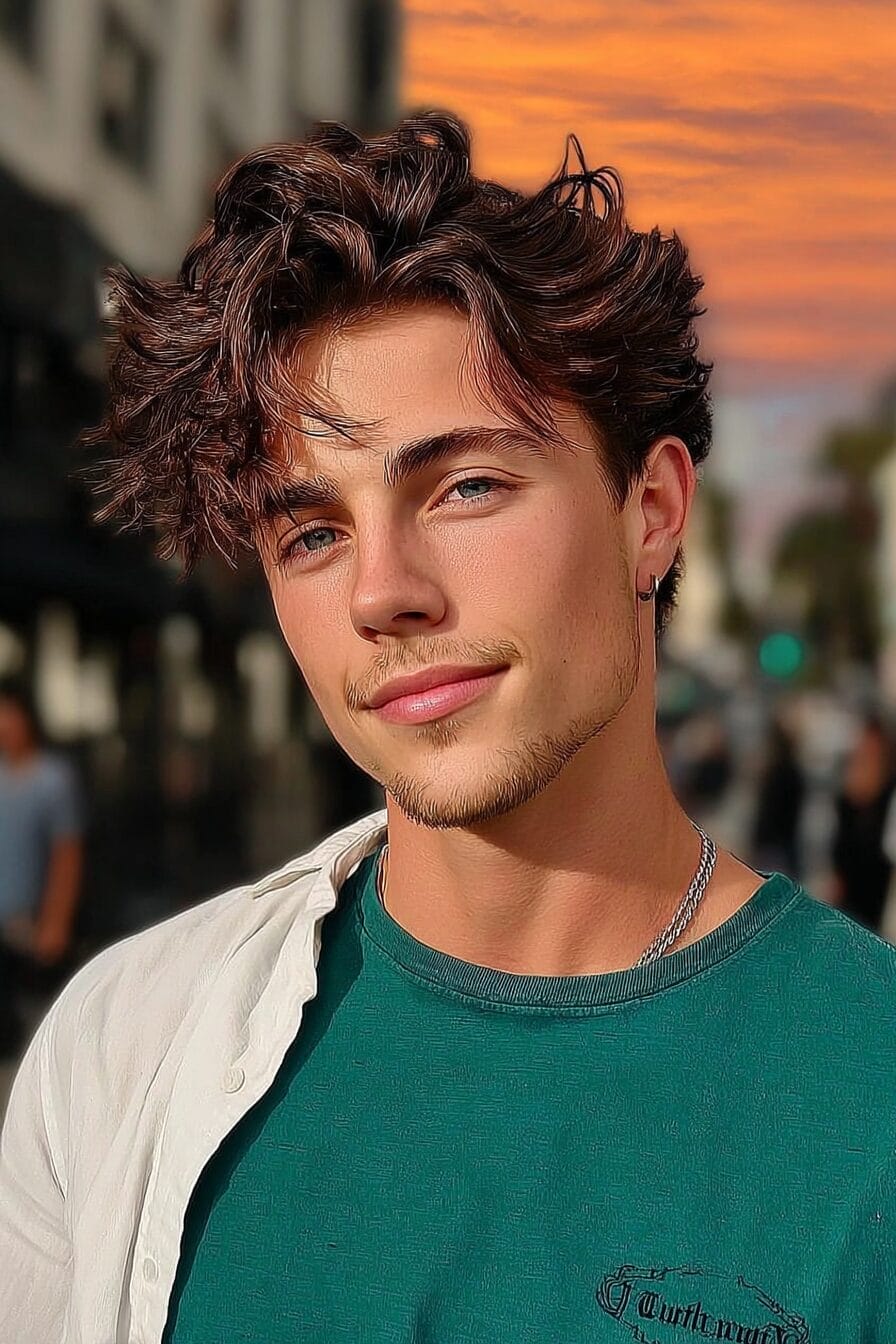
My favourite for the guys who want curtains without the commitment. The fringe still splits down the middle, but it’s shorter — about cheekbone length — and the sides are kept longer than a standard taper so the whole cut looks grown-in and effortless. Great on softer face shapes because the low-contrast sides don’t harden your jawline. Ask for “a soft curtain fringe, no fade, sides scissored to blend.” A pea of styling cream through damp hair, air-dry, done.

Textured Curtain Cut
The textured version is the shape 2026 is really buying. Instead of a slick curtain, I point-cut and slide-cut through the length so the top breaks into piece-y sections. It gives movement without any product doing the work — hair falls in loose separated strands rather than as one solid sheet. Works on straight, wavy or fine hair, and it’s the version I’d push if you don’t want to style every morning. Show your barber a photo, then ask specifically for “a lot of texture through the ends, so it looks lived-in.” Matte clay, warmed between your palms, raked back — that’s the whole routine.

Curtain Cut with Undercut
The undercut version gives you contrast without a fade. Sides and back go on a 1 or 2 guard straight up to the parietal ridge, and the top stays long enough — 5 to 6 inches minimum — to fall over the shave line. Ask for a “disconnected curtain with a 1-length undercut.” It works especially well on thick hair because the shaved sides take the bulk out. Downside: you have to be comfortable with the look when the top is pushed back and the underneath is exposed. If that feels too sharp for the office, choose the taper version instead.
Messy Curtain Style
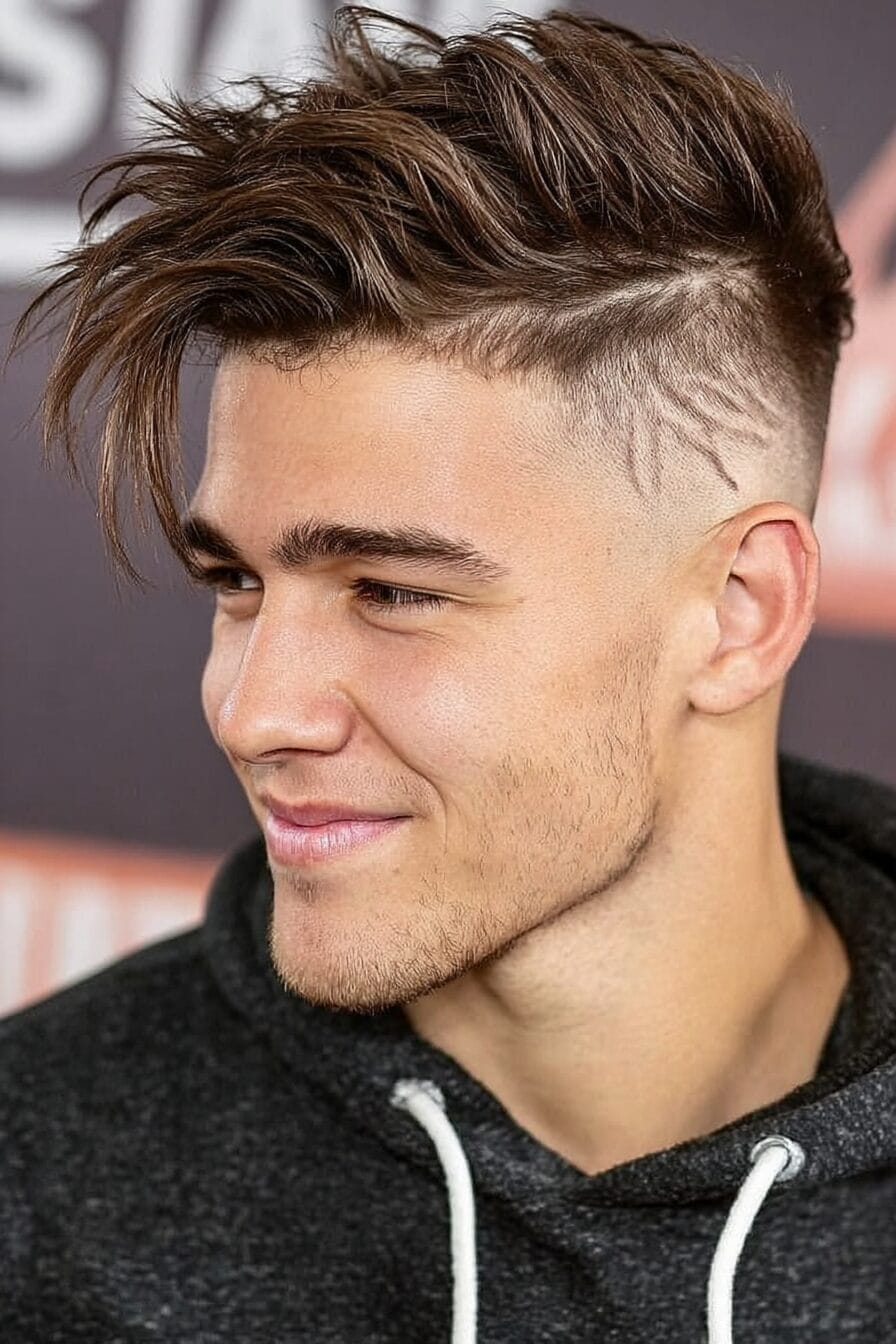
Messy isn’t “didn’t comb it.” It’s a deliberate cut — heavy internal texture, uneven perimeter, longer bits left near the temples so the part never sits perfectly. This is the style I give guys who admit they won’t blow-dry. Rough-dry with your hands, break it up with a fibre paste, and you’re out the door in three minutes. Best on wavy hair. Ask for “messy curtains, deconstructed, no straight lines.”

Curtain Cut with Skin Fade
The high-contrast option. Sides drop to a 0 skin fade, top stays 4 to 5 inches with the classic centre split. It’s the version I cut most on younger clients — it photographs sharp and lasts about three weeks before the fade edge softens too much. Book a tidy-up every 2 to 3 weeks or the shape falls apart fast. Not the right pick if you want low maintenance. Ask for “a skin fade to a curtain top, drop fade around the ear.” A drop fade curves down behind the ear and keeps the fade out of the temple area — kinder on receding hairlines.

Short Curtain Cut
A short curtain is the version I recommend for a first-timer. Top is 3 to 4 inches — enough to split the middle, not enough to flop into your eyes. Sides on a 2 guard tapered up. The whole cut looks intentional even on the third-day hair when you didn’t bother styling. Great for round and heart-shaped faces because the added height off the crown lengthens the face without the fringe hitting your cheekbones. Ask for a “short curtain, 3 inches on top, 2 tapered on the sides.”

Long Curtain Hairstyle
For hair sitting past the ears. The centre part goes all the way through the back and the length just runs. This version needs a proper cut — long layers, invisible layering through the crown — or it turns into a triangle. I book long-curtain clients every 8 to 10 weeks and I’m mostly maintaining shape, not length. Straight or slight wave holds it best; tight curls need a different long shape. Damp hair, styling cream, comb, air-dry. Wet, this looks like a wig; only judge how it’s going to sit once it’s dry.

Medium-Length Curtain
The 4 to 5 inch middle ground. This is the length that lets you wear it as curtains today, comb it back tomorrow, and slick it down for a wedding on Saturday. If you’re not sure which version you want long-term, cut it to medium first — you can commit to a shape once you’ve lived with the length for a few weeks. Ask for “medium-length curtains with layered ends, sides scissored short but not faded.” Pair it with a lightweight cream so it moves. Fine hair needs a spray of sea salt at the roots for lift; thick hair skips that step.
Wavy Curtain Cut
If your hair waves naturally, don’t fight it — the wavy curtain uses your texture as the finish. I cut into the length with a razor rather than scissors so the wave breaks freely at the ends instead of piling up thick. Sea salt spray on damp hair, scrunch, and let it air-dry. Diffuser if you can’t wait. This is one of the top three most-requested versions in 2026, and it’s the one I’d put money on carrying into next year too because it’s so low-effort. Ask for “wavy curtains, razor-cut through the ends, don’t take out the wave.”

Curly Curtain Style
Curls change the whole conversation. On a 2C to 3B pattern, I cut curtains dry so I can see how each curl actually sits — wet curly cuts almost always come back too short. Length lives at about 5 inches so the curls have room to spring but don’t collapse into a triangle. Curl cream on soaking-wet hair, praying hands to smooth, then squeeze it dry with a microfibre towel. Never a regular towel — the loops break the pattern. On tighter curls you might need a leave-in first. Ask for “curly curtains, cut dry, keep the length, thin the interior only.”

Straight Curtain Cut
Straight hair is the easiest surface for a clean curtain but the hardest to give volume. If yours is fine and flat, ask for a bit of internal layering at the crown — nothing you’ll see from the outside, just enough to stop the roots sitting glued to your scalp. Blow-dry from back to front, brush overhead first (that trains the lift), then split the part with your fingers. A tiny amount of matte paste through the ends only — roots stay untouched or the whole thing goes flat by lunchtime.
Beachy Curtain Waves
Summer version. Longer than short-curtain, shorter than long, cut with the ends left rough so they look weather-worn. Salt spray does most of the styling. This is my go-to for guys who want the cut to look best when they’re NOT trying — walking off the beach, out of a swim, hair drying in the sun. Blond and mid-brown hair holds the beachy look most convincingly; on jet black it can read as unstyled instead of undone.

Curtain Cut for Round Faces
A full curtain on a round face makes the face look rounder — both sides framing equally just fills out the width. I cut a taller version: 5 inches on top with the fringe slightly asymmetric, sides tapered close on a 2 to draw the eye vertically. Ask for a “curtain with height at the crown, sides kept tight, one side of the fringe slightly longer.” This is my most-requested face-shape adaptation, and it’s the one where the wrong version does the most damage — make sure your barber understands what you’re trying to correct before they start. Not sure of your face shape? Run through the face-shape detector in 30 seconds first.

Square Face Curtain Style
Square jaws take the classic curtain beautifully because the horizontal jawline balances against the softer curved fringe. Length can go longer — 5 to 6 inches on top — because the strong face carries it. Keep the sides scissored rather than faded; a sharp fade next to a sharp jaw over-does the geometry. Ask for a “full curtain, scissors only, soft edge behind the ears.”
Business Curtain Cut
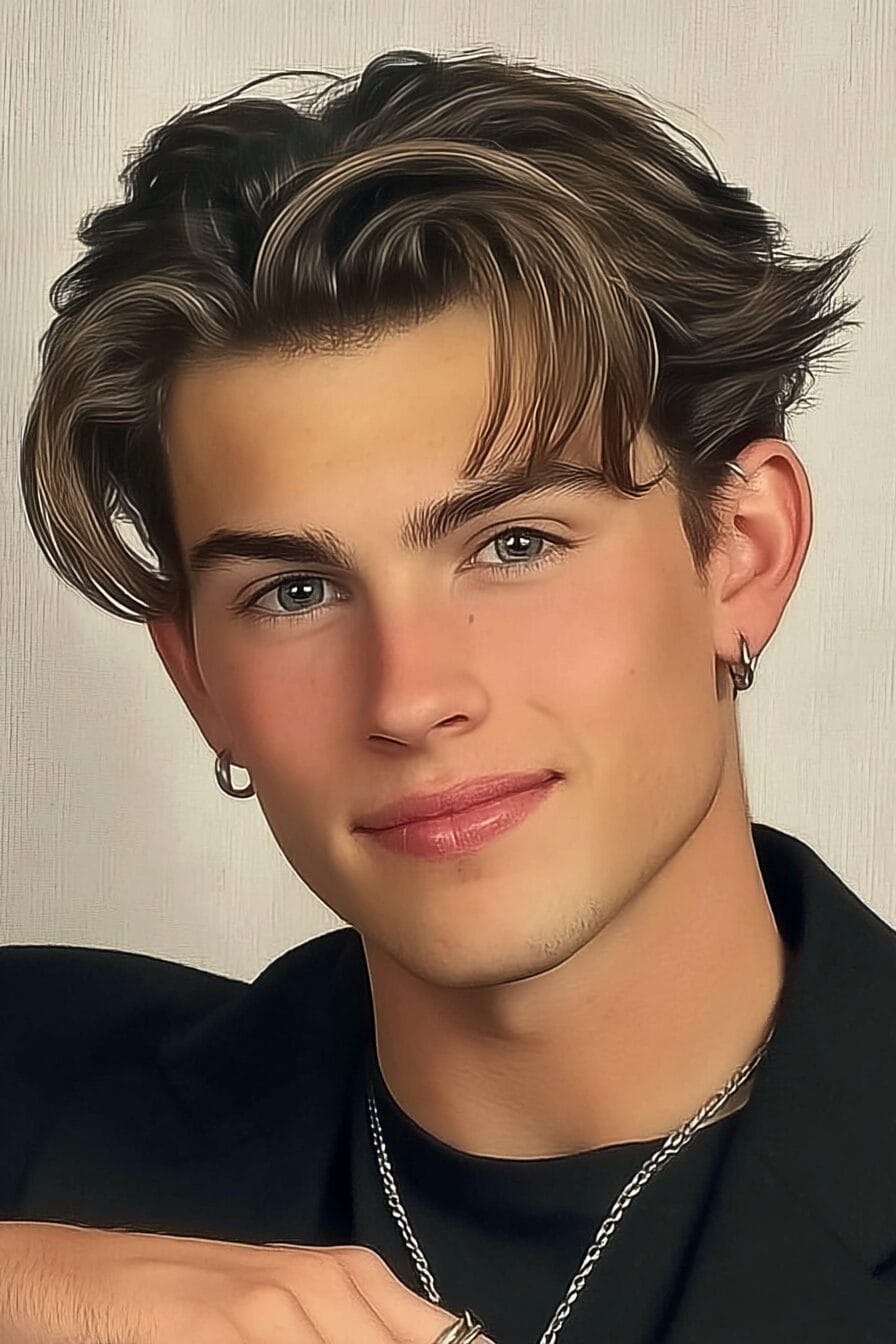
For the guys asking “is this OK for the office?” Yes — but you need the boardroom version, not the club version. That means: 3 to 4 inches on top, no fade, sides tapered clean with the shear-over-comb finish. The centre part is subtle rather than statement. When it’s combed properly it reads as a smart, part-side style; when it’s let down it still curtains. I’ve cut this on lawyers, consultants and one CEO who told me his previous barber wouldn’t attempt it. Ask for “a conservative curtain, tapered, no undercut.”

Asymmetrical Curtain Cut
Same silhouette, one side longer than the other. The part sits slightly off-centre and one panel of fringe falls to the cheekbone while the other stops at the eye. It sounds fussy but it’s actually more forgiving than a true curtain because the imbalance hides an uneven face or a widow’s peak. Ask for “an offset curtain, one side an inch longer.” A styling cream is enough; anything heavier and you lose the natural drop that makes it look intentional.
Sun-Kissed Curtain
Not a haircut in itself — a colour treatment over any of the versions above. Balayage or subtle highlights through the front sections catch the light where the fringe falls. It ages beautifully because the roots grow out into the base colour rather than showing a hard line. If you’ve never coloured your hair before, ask for a soft face-frame balayage first — that’s the least commitment and the most flattering starting point. Book a gloss every 6 weeks to keep the tone from going brassy.

K-Pop Inspired Curtain
The K-pop curtain is the version dominating my chair for anyone under 25 in 2026. Softer, glossier, blunter perimeter, fringe cut straight across at the eyebrows before it splits. Sides sit long — often just cleaned up around the ear rather than tapered. Frequently paired with a subtle two-tone colour: darker roots into a lighter mid-length. Ask for “K-pop curtains, blunt perimeter, long sides.” A tiny amount of hair oil through the ends is all the styling this needs; the shape does the work. It sits close to the broader Korean cut family — worth a look if you want alternatives.

Euro Football Curtain
What Rodri, Odegaard and half a dozen Bundesliga players are wearing. Slightly grown-out, effortless, always looks like it’s been through a match. Long fringe past the eyebrows, sides tapered but not too tight, the whole cut worn with just enough product to hold its shape after a run. This is the version guys in their 30s pull off best because the slightly “done nothing” look reads as confidence rather than teenage neglect. Ask for “a football curtain, tapered not faded, long enough to push back off the pitch.” A matte styling cream is your entire kit.

How to Ask Your Barber for a Curtain Haircut
Bring two or three photos — not one. One photo is a wish; three photos are a description. Try to pick photos of guys with your hair type, not the perfect model version, so your barber can see what the cut will actually do on you. If you can find a photo of you six months ago with hair a similar length, bring that too — it saves 20 minutes of guessing.
Once you’re in the chair, use these words: “curtain,” “middle part” and then whichever version you want (soft, textured, undercut, fade, business). Then be specific about three things — fringe length (eyebrows? cheekbones? jawline?), what happens to the sides (scissored? taper? fade? undercut?), and how much texture you want left in the ends. Nine out of ten bad haircuts I fix started with the client being vague about one of those three things.
Guard numbers I use most often on the sides: a 2 for tight tapers, a 3 for a balanced blend, a 4 for a soft grown-in look. On top, curtains almost always want to be scissor-cut — anyone reaching for clippers on the length is about to give you the wrong cut. If your barber says “let’s just take a bit off with clippers on top,” that’s the moment to politely stop them. Read how to ask for a haircut once before your next appointment; it saves you the awkwardness of course-correcting mid-cut.
How to Style a Curtain Haircut at Home
Curtains are one of the easier cuts to style at home because the shape does most of the work. You’re not building a fake volume off flat hair the way you would with a slick back — you’re just guiding a shape that already wants to fall that way. My five-minute routine, in order:
1. Start damp, not wet. Towel it dry until it’s just damp. Wet hair takes forever and is harder to shape.
2. Choose your product for the finish you want. Styling cream for softness and hold, matte clay for texture, sea salt spray if you want lift and grip in fine hair. Warm it between your palms before it goes anywhere near your head.
3. Push everything forward first. Even if you’re parting it in the middle, comb or blow it forward before you split it. That trains the roots to lift.
4. Split the part with your fingers, not a comb. Fingers create a softer, more natural centre line. A comb line looks drawn on.
5. Leave the ends alone. Whatever product you used should already be there. Don’t keep re-touching it — the more you fuss, the more the cut looks styled instead of lived-in.
Two extra notes. First, dry your hair every day, even on your rest days — sleeping on damp curtains bakes in a set that’s a nightmare to fix in the morning. Second, wash with a shampoo that isn’t stripping. If your ends feel like straw a couple of days after a wash, your product isn’t the problem, your shampoo is. Any barber-brand daily shampoo or a gentle sulphate-free option works. If you want the full grow-out and product routine written up, we’ve got a full men’s styling guide here.
FAQs: Curtain Haircuts
How do I know if a curtain haircut will suit me?
Curtain haircuts suit more men than any other style I cut. Oval, rectangular and diamond faces wear the classic version best, but round and square faces can wear the adapted versions above (taller crown for round, longer scissors-only version for square). The two situations where I’d push a client toward a different cut are: very fine, sparse hair where curtains sit flat, and receding hairlines where a middle part draws attention exactly where you don’t want it.
How often should I trim my curtain cut?
Short curtains: every 4 weeks. Medium curtains: every 6 weeks. Long curtains: every 8 to 10 weeks — you’re maintaining shape not length. Skin-fade versions need to be tidied every 2 to 3 weeks because the fade edge softens fast. Book the next appointment before you leave the chair; the cuts that grow out worst are the ones people forget about.
What products work best for styling curtain haircuts?
Styling cream is my default recommendation because it’s the most forgiving — it moves with the hair and doesn’t lock the shape. Matte clay if you want more texture and less shine. Sea salt spray at the roots if your hair is fine and needs lift. A tiny amount of hair oil through the ends on the K-pop and glossy versions. Whatever you use, warm it in your palms first and start with less than you think — you can always add more.
How long does your hair need to be for a curtain cut?
You need at least 4 inches on top for a real curtain. The fringe should reach your eyebrows minimum — that’s the point where you can actually train the part. Growing out from a buzz cut normally takes 3 to 4 months, and there’s a rough 6 to 8 week awkward stage in the middle. Push through it. Use light styling cream during the grow-out and it looks intentional rather than untidy.
Are curtain haircuts still in style in 2026?
Yes — curtains are one of the top three most-requested men’s cuts in my chair right now. The shape has moved on from the flat, sharp 90s version into looser, more textured and often curly variations. That’s exactly why it’s lasting: it keeps re-inventing itself. I’d expect it to stay dominant through 2026 and well into next year.
Was this article helpful?
Ready to Find Your Perfect Cut?
You’ve read about the styles. Now find the one that fits YOUR face shape, hair type, and lifestyle.

Khamis Maiouf is a professional barber who graduated from Hinckley College in England with a Level 3 qualification in hairdressing. With over 20 years of experience, he is an award-winning barber who has mentored numerous students and styled thousands of clients. A recognised expert featured on StyleCraze (20M+ readers).
Credentials: Level 3 Hairdressing (Hinckley College, UK) • 20+ Years Professional Experience • Featured Expert on StyleCraze • Founder of Book of Barbering